Lewis Carroll

Alice20in20wonderland Found some Lewis Carroll sites to work on with Alannah and thought I would pass them along. This one has a number of links including lesson plans. Discovery School has a plan that includes surrealist art study. While you are there check out the lit section.  Did you know they had a Great Books program online?? We haven’t really investigated some of these artists so may go down that rabbit trail. This one focuses on different Alice illustrators and is geared for younger readers.

I have been rolling over some of his quotes this morning. Thought I would share while we are on the subject:

On teaching: "My one pupil has begun his work with me, and I will give you a description how the lecture is conducted. It is the most important point, you know, that the tutor should be dignified and at a distance from the pupil, and that the pupil should be as much as possible degraded…. So I sit at the further end of the room; outside the door (which is shut) sits the scout; outside the outer door (also shut) sits the sub-scout: half-way downstairs sits the sub- sub-scout: and down in the yard sits the pupil.
The questions are shouted from one to the other, and the answers come back in the same way—it is rather confusing till you are well used to it."

On God: "I have had prayers answered – most strangely so sometimes – but I think our heavenly Father’s loving-kindness has been even more evident in what He has refused me. "

and finally: "Begin at the beginning and go on till you come to the end; then stop. "  And now, I am going to find my chart and do just that. : )

Plain and Simple

  Before I share this story I must add the disclaimer that I sat on it for some days hoping to do it justice. I fear I haven’t been able to tie the miscellaneous experiences together as coherantly as well as they fell together in my head.  I decided to forego compositional perfection and just write.  My excuse for random thoughts is that the number of children now officially exceeds the number of hours I sleep at night lol! 
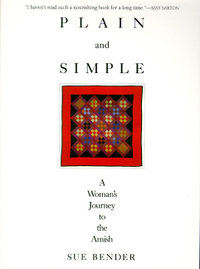
Plain_and_simple_2  I recently came across an old friend in the thrift store. Not the flesh and blood type, but rather the kind you find between the covers of a well-loved book. I had first stumbled across this book, Plain and Simple, when we were relatively new parents. Our first two boys were itty bitty and we lived in tight government quarters. All the while I was yearning to be elsewhere. When I saw the Amish quilt on the cover I grabbed it. I was hungry for any snippet of simple rural living. I realize now I missed a good portion of the author’s message and instead of taking her intent to heart, it just fed my discontent. This would plague us for years to come. Ironically, now that we do live rurally the book has resurfaced in my life and its message is very clear. It was never about where you were, it was about where your heart was. 

   Sue Bender was an artist, a counselor, a wife and mother, suffering from another kind of discontent – a restless search for purpose – when she saw her first Amish quilt in a dept. store display. She found its disciplined geometrics and color scheme haunting. The urge to learn more about the women who created such puzzling beauty finally propelled her to take a trip through Lancaster County. Discouraged by the tourism she drove further on to Amish settlements in the Midwest. There she met the people who would come to shape her future. 

   She contracted two women to make her some faceless Amish dolls. This led to several other women’s contributions and many letters exchanged. The dolls and the quilts began to symbolize for her the difference between their lives and hers.  Eventually her drive to understand and articulate led to an unlikely invitation to stay with an Amish family for several weeks. This book lays out the discoveries she made, discoveries with unexpected ramifications for city dwellers.

   She expected to come away from her journey telling people to move to the country and lose their appliances and all would be well.  However the message she left with was not where to be, nor what to be doing, but how to look at the ‘where’ and the ‘what’. It was about how to “be” and making peace with our place in life. She found the Amish quilt patterns to be a metaphor, both for their way of life and for the lessons she left there with.

   One of her most important insights was that the Amish seemed not to differentiate between work and play. She writes. “Noone rushed. Each step was done with care.  The women moved through the day unhurried.  There was no rushing to finish so they could get on to the “important things”. For them, it was all important…”  This was a sharp departure from her struggle to get through the monotonous, drudge type work in her life so she could do the really ‘fun’ activities. As a result, she spent her days suspended in a sort of futile desperation, fighting the necessaries and longing for the payback.

   An insightful artist friend explained to her that, “If accomplishing is the only goal, all that is takes to reach that goal is too slow, too fatiguing- an obstacle to what you want to achieve.”  Pg 85  This was all too true. He also pointed out that the source of the discontent was not the necessary work itself but the struggle against it, “Argue your limitations and they are yours.”

  They were certainly mine for way too many years as I fought long and hard against the limitations of our place in life. I was unhappy with our urban homes and our transient lifestyle. I felt hemmed in by the chores that never seemed to be completed to my satisfaction. This led to resentment towards my husband and though I didn’t admit it then, likely resentment towards God for not making another way. It was such a wasted opportunity because as long as my happiness depended upon our circumstances it would remain fleeting and just out of reach. That discontent would follow us to our rural home and to the incredible workload we found here.

   We had to learn to love the work, to love the limitations that every place and time impose upon us. We had to learn to let go of all the options that were no longer ours because of the choices we had made. Only then could we really thrive.

  Interestingly, Bender found that embracing a characteristically Montessori principle was key to her own happiness, “Having limits, subtracting distractions, making a commitment to do what you do well, brings a new kind of intensity.” Pg 140 She learned that the real message was not the quest for a different life but rather a different view of the life she had, “I found no shortcuts. Satisfaction came from giving up wishing I was doing something else.” Pg 121

   This would be true for us as well. Whether we are homemakers or have careers outside the home, we are tempted to covet.  There is always a more attractive pastime waiting in the wings to call our attention away from the task at hand, making demands upon our peacefulness. Even now I find myself tempted to rush along to the next thing. It was my six year old Aidan, who reminded me of that error the other day, as I urged him not to waste time and to ‘move along’. I can’t even remember now what he was doing because his reply went straight to my heart. He said, “But I am not wasting time, I am spending time.”  Out of the mouths of babes. 

  Bender found that Amish children, like Montessori children, share this outlook, “A child learns from an early age the value of work – that work is enjoyable, important, and should be respected.” She found this attitude is carried with them to adulthood, “The Amish find meaning in work itself.  Work is never a stepping stone to success or advancement but a challenge to do whatever you are doing to the best of your ability.”   Pg 61

   This was not about rushing to get to the good stuff.  It was about making all of life the good stuff by giving it your undivided attention, which is ultimately the only way to truly find satisfaction in your tasks. This wasn’t any easy transition for an adult who had been conditioned to think otherwise. She relates, “I whined, kicked, and screamed, and persisted.  Sticking with something for a long period of time, the day in and day out doing it, the living with it, was teaching me humility and patience I hadn’t known before.”

   This would be our experience as well. We learned we could fight the limitations of this way of life or we could let those limitations teach us contentment, patience, and the true gift of finding joy in all circumstances as St Paul advises us to do.

   Elizabeth Elliot says this about suffering: “–it’s having what you don’t want or wanting what you don’t have.” As long as we continue to fight against those things we lock ourselves into suffering. If we can embrace our circumstances and all the mundane tasks that fill our days as the will of God we can release that suffering and find the joy God intended for us. The “Plain and Simple” message was less about a particular group of people or an antiquated way of life and more about acceptance and making peace. I hope to, someday, embody those principles as well as my six year old already does! 

Double the luck?

Rainbowl Rainbowr

There is a LOT of sky around here. (that’s the really nice way of saying there isn’t a lot in the way of it lol!)  When it storms we are often treated to some spectacular displays.  This would be one of them – the double rainbow.  Although with the naked eye we could see both complete arcs stretching across the sky, the camera could not capture them in one frame. You have to just imagine these images all together. 

Think this means there were two pots of gold?

Schoolhouse spotlight 8/26

   We started school back up this week. It was a light week but the children are getting back into the swing of things well. I have always been skeptical of "to do" lists since too often they are mere speculation on my part. We regularly end up doing even more exciting things than my little planner could have imagined.  I have taken to keeping "done lists" instead and recording our work that way.

   We have a steady school diet of core subjects such as math, language, reading, and religion. To these we add the Charlotte Mason stand-by’s – nature notebooks, artist and composer studies, history timelines, and so on. Toss in a hefty dose of Montessori materials and you have a good picture of the Schoolhouse. That’s the background for you. : )

100_2959   This week we spent some time on the plant studies we have been working on this summer. Throughout the past months they have been getting books about plant life cycles and doing experiments, including the aforementioned gardening project. Our favorite resource by far has been Janice Van Cleave’s Plants bk. This book was full of experiments we were able to do and a couple of awesome paper models.  This week they created a pollination model and painted our sunflowers on which they spied several bees. They did a very nice plant parts model earlier this summer. The pics I took of that aren’t responding to any amount of ‘come out, come out wherever you are’ however.  Will try to unearth them this week.

100_2955100_2953 This week’s  nature notebook pages were about frogs for obvious reasons <g>

100_2954The girls made more geography term pages.

We are still going strong with the Signing Time videos. Several things fell into place that are developing into a stand alone unit. The story at church last Sunday was about Jesus healing the deaf man. They narrated that. Then Moira had to choose a new chapter bk to begin.  She pulled Helen Keller off the shelf, not realizing she too was deaf and blind. The Magic Schoolbus bk at the bkmobile was about the five senses.  They loved that one and as we worked through the videos and bible story Aidan soberly pointed out that we ‘really needed to read more of that book and figure this out.’  So that is the direction we headed. We discussed the sense organs and the nerves leading back to the brain. We discussed the parts of the brain that registered the senses and how if those areas were damaged you still could not see/hear/etc.

Alannah is finishing one of her first ‘real’ lit works, Alice in Wonderland. Colin had suggested it to her several weeks back and she took his advice. Another wonderful coincidence – each fall the library system chooses a classic to be its all area ‘read’.  They have promotional events through the school year such as plays, presentations, and so on.  Guess what this year’s title is?  Yep!  Alice.

Asher is halfway through Story of a Soul. He is also working through What to Listen for in Classical Music by Aaron Coplandand ‘Tis by Frank McCourt. It is a sequel to McCourt’s Angela’s Ashes and hopefully less graphic but don’t consider this a ringing endorsement.

Our current family read aloud is The Year of the Boar and Jackie Robinson.  When Asher got wind of it he said didn’t we just read that?  As it turns out I read it to him and his brothers about 8 years ago when Allen was in Saudi Arabia. Guess it made a favorable impression! Time to treat the younger set to this book.

100_2940_4100_2941  Saturday was spent rotating the horses to a new pasture and moving the water troughs etc. Then they tackled the new goat shelters. We helped friends move a few weeks ago and in return they gave us these gigantic dog houses on their new property. Allen and the kids measured and cut new larger openings for the does and moved the shelters into their pastures. Then they had to restring the fence. LOTS of practical life happening there! It does my heart good to see them run and retrieve the correct tool when he calls for a Phillips screwdriver or a drill bit.

That wraps up week one!

Simplicity pt 2 – serving others

A thoughtful post on Loving Our Homes today raises some very important questions for those of us seeking to simplify.  Before we even tackle the specifics of HOW to best do our work we should rightly be discerning which of all our tasks are rightly ours to do. How much which was never intended for us to do has crept into our schedules?  I have always felt that God gave us enough time to do His will….but  that we are not necessarily guaranteed even a smidge more for our own agendas.  With that in mind if our schedule becomes impossible the first thing we do is to take a hard look and prioritize.

Along the lines of WWJD (what would Jesus do?) the question is What Would He Have Us Do?  Which things in our busy schedules are edifying?  Which are truly blessing our families and others? Which are draining us of needed resources – be they physical, emotional, or whatnot – without significantly improving a situation? There are times when a given activity keeps us spinning our wheels. There are times when a given activity does help others, but upon reflection we have to acknowledge that we are not necessarily the only, nor in fact the best, ones available to fill that role.  In fact, we may well be neglecting another task, one for which we are indispensible, while doing this other activity.

Discovering where we are truly indispensible and effective and where we are not is a necessary step towards a saner life imo. We cannot do it all so we must prayerfully consider what we are truly called to do and try to release the rest, even if for a season. This is constantly driven home to me and is likely the biggest challenge I have faced in reaching my goal of simplicity. I feel terribly guilty saying no.  I have come to realize often this has more to do with pride than with genuine feelings of helpfulness. Too often saying yes to an outside task has caused me to neglect a necessary duty for my husband or children. That isn’t true charity, which begins at home.

I am learning.  Slowly. Posts like Mrs. Catherine’s help remind me.

“oooh oooh ooh!”

Remember Horseshack raising his hand enthusiastically when Mr Kotter asked a question?  Imagine me doing that now! <g>

Jen sent me this link: High School Ace and I can’t say enough good things about it.  It’s got sooo much packed into one place it caused me to do the happy dance. Check out the subject area links. The English section alone links to cyber lit guides, word of the day, test prep q of the day, poem a day, spelling rules, grammar rules and exercises, the MLA styleguide (a must have!), research paper how tos, plagiarism notes, and more! The history sections link to all major eras, figures, maps. There are science charts and labs for all branches, links to foreign language games and lessons, and math exercises for each level of hs study.

Students can also analyze the daily news, learn study skills, brush up on health topics, and play thinking games. Can you say one-stop shop! : )

and again

"Making the decision to have a child is momentous. It is to decide forever to have your heart go walking outside your body." -Elizabeth Stone

100_2878 Another child of ours reaches legal adulthood. Zach turned 18 this week. I have discovered that if you look away for just a moment they have a tendency to do that. Here is a snapshot from the birthday dinner. 

Scrapbooking Primer

I promised Donna Marie  this post some months ago now.  I hope she wasn’t holding her breath! : / Please accept my apologies for such a belated response!

The question was, "What book or two do I need to begin?"  That is such a difficult question to answer! I am a visual person and I had to begin with magazines and images to sort through in my head what it was I was envisioning. Once I had that I could proceed. My favorite magazine is Simple Scrapbooks.  I wouldn’t be without that one!  Creating Keepsakes is a great magazine but focuses more on cutting edge techniques and pages very full of materials and high tech techniques. Those are nice if you are particularly skilled at looking at such a page and picking out one or two parts thereof you might want to incorporate into your work.  Not so good if you want grab and go ideas.

Simple Scrapbooks, the book is a great beginning title.  Stacy Julian shows several different types of scrapbooks. Her new book The Big Picture is even more fun.  Cathy Zielske’s Clean and Simple Scrapbooking and the sequel to it banish even more misconceptions about how you "ought" to scrapbook and provide easy directions for quick pages.  For instance, you do not need to scrapbook ALL your pictures, nor even all your events. Choose the photos that speak to you and tell the story behind them. You do not need to lots of accents (stickers, die cuts, patterned pattern) and in fact too much of a good thing is not so good in this case. You don’t need to mat all or even any of your photos. You don’t need to even crop the pics. A new CK bk Easier Than Ever Scrapbooking will provide more layouts for standard sized photos. for that matter, you don’t even need photos! check out the alternatives here: Scrapbooking without photos and here  and here. And my favorite – you don’t need to be "caught up".

Becky Higgins’ series of Creative Sketches bks – Vol 1 and Vol 2 – are titles I pull out EVERY time I scrap. In fact many of my pages are based on BH sketches. She lays out a blueprint which you can begin with and then incorporate your own papers and accents. Her approach is also very clean and uncluttered and easy to copy. All good things! Not ready to buy before you try? I never am! You can check out her sketches at the CK website. Here are a few other sketch sites, though some may not be as well designed as Becky’s:

Scraps Ahoy

Littlebit.com

creative scrapbook sketches

If you are looking for very basic how-to instructions here are a few websites to get you started:

Your first page
Learn2Scrapbook

If you aren’t sure you want to dive in yourself but would like to introduce the craft to your children then try these:

Scrapbooking with Kids

Starting with Kids

kids pages at makingfriends.com

You will need some "stuff" to begin:

basic toolkit  In the end you really only need scissors, paper, black pen, and adhesive. These should be acid free since regular paper/pens/etc will fade anddamage your photos. Paper can be easily stored in a magazine holder with a cupholder for the rest. I would likely place those next to the computer because I am more apt to print any journaling and titles than to hand write. I would also not be without a personal trimmer – cheap, fast, straight lines. Need I say more? <g>

If you want your "stuff" even more portable you might check into the storage options at Cropper Hopper  In particular visit the organization tips link. Making Memories has very nice upscale storage aids. Fwiw, Target stores often carry similar items so you might want to surf for ideas here and then visit your local Target.

If this develops into a dearly loved hobby you may want to have a dedicated *space*.  I have had such a space in several homes. Initially it was a converted hall closet. We outfitted it with a remnant of countertop slab from Home Depot for next to nothing. I rolled Sterilite storage drawers and stool underneath the counter, nailed baskets to the side walls to contain the misc supplies and then had magazine holders and albums and idea books along the wall in front of me. (countertop is pretty deep) Here are some other options:

Armoire

Scrapjazz Organization – your room

Becky Higgins tips

Lisa Bearnson scrap space

My favorite scrapbooking internet site (after Simple Scrapbooks mag) is Twopeasinabucket   Ahhhh, 2Peas! Source of delightful fonts (storefront), theme album ideas(creating garden), poetry and quote search (peasoup) , a message board and a vast gallery of pages to browse. They have an awesome search engine at their gallery.

I will begin uploading a new album to the sidebar this week full of our family scrapbook pages fwiw.  I hope this helps encourage you. Scrapbooking doesn’t have to be complicated, time-consuming, or messy. Then again, it can develop into a true art form and source of reflection and self-expression. Take it as far as you wish. Now go grab a photo y’all! And don’t forget to share your pages with me when you finish!