N is for Noodle
ASL N and Noodle
N template and tracer pages. Make a Noodle Name N – glue alphabet pasta onto the template to make the child’s name.
Math:
Nine
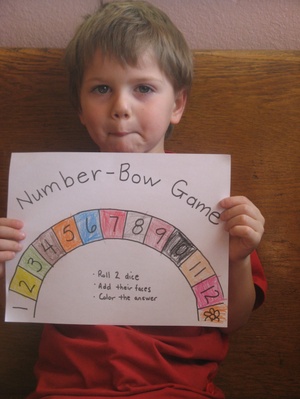
Number games. Peggy Kaye’s Games for Math is a fun book. She is online now. We made up a Number Bow game card to practice addition. Kieran loved it. Read – LOVED it.
You can print number recognition cards here and here. The latter is from Jan Brett’s site which has a plethora of wonderful printables for math and language.
No printer? No problem. Use large index cards and marker. Write the numeral on top and adhere the appropriate number of stickers below. Make blank cards with just the numerals and some counters for the child to practice with. You can also make nice Number Books by holepunching the number of holes on the card, placing that number of paper clips onto the card, gluing orzo noodles to the card etc.
Montessori trays:
Noodle sort – provide a container of various shaped dry pasta to sort into a muffin tin. Noodle scoop – fill flat bucket with small pasta to pour and scoop into cups and bowls. A slightly older child could fill out this chart by counting how many of each type of noodle were found. Nuts are another N item that could be used. Large nuts still in the shell are great for transfering with tongs.
Want to include older kids? Try some activities from this Noodle Unit.
N is also for Nienhuis Montessori, the granddaddy of Montessori suppliers. They are also the cadillac supplier and cost a pretty penny. I include them here because their catalog is superb and you may be able to make your own materials more easily once you see the photos.
Arts/Crafts:
The smallest funschooler can make noodle jewelry with little assistance. One option is to lace large dry pasta pieces onto shoelaces or yarn for necklaces or bracelets. Amp it up by letting them paint or dye the noodles first.
You can also glue colored or plain noodles onto a frame or any other hard surface as a collage. These noodle critters are darn cute.
Literature:
Strega Nona – classic Tomie tale about noodles gone nuts
On Top of Spaghetti by Paul Brett
Everybody Brings Noodles – this is a longer book for kids who can sit a bit and follow a story line.
Pino and the Signora’s Pasta by Janet Pederson
The Story of Noodles by Ying Chang Compestine – the Kang boys from the Kite week are back
Spaghetti Eddie by Ryan San Angelo
Classic Lit – The Nightingale by Hans Christian Andersen (link to online copy)
Science/snack:
Make several varieties of noodles this week. Think outside the box, perhaps using some of the ideas in Everybody Brings Noodles. Aside from noodles and sauce you could make spaghetti pie or sweet noodle dishes like kugel.
Songs:
On Top of Spaghetti
Character – Neatness Counts. Work on making things nice and tidy before leaving the school room or bedroom this week. (“Did you hear that, Kim?” “Why yes, I did. Thank you for the reminder!”)
It is also a good week to work on being Nice. Yes mom, you too.
Another song from this site:
How Nice I Am (Sung to “How Dry I Am”)
How nice I am; I’ve learned to be.
I raise my hand before I speak.
How nice I am; I’ve learned to be.
Sit in my chair most properly.
How nice I am; my best I do.
I use the words “please” and “thank you.”
How nice I am; try to be kind.
I wait my turn and stay in line.
How nice I am; I’ve learned to be.
I say, “Sorry” and “Excuse me!”
How nice I am here at my school.
I try to live “The Golden Rule.”
Bible:
That would be Noah of course! You can make his ark here.
Sequencing cards here.
St Nicholas – he was real.
A Note about Notebooks. What follows is how I keep my sanity teaching six at a time from preschool to high school. In the early years the notebook is composed of the minioffice pages I linked to on M week. We go over the pages several times a week and voila the early education stuff is covered. As the kids approach K-1st and beyond I use a system much like this. Penmanship pages and math sheets etc get placed into colored plastic pockets in the binder. When the children finish a page it goes to the back side pocket. There are cards that say things like ‘read with mom’ or ‘do your math flash cards’ as well. When they do that thing they move the card. When all the cards are in the back pockets of the dividers they have completed their week’s work.
I can’t tell you how incredible this is. No flipping through lesson plan books. No kids waiting on mom for the next thing. Workbooks are a dirty word in homeschool circles but I will let you in a secret. There are some extremely well-written worktext books that speak directly to the student which allows for self-teaching. They do not insult the child’s intelligence. Many of my favorites are on the sidebars – the Critical Thinking Press and Cuisenaire series are awesome. Spectrum and Modern Curriculum Press are very good too. We use excellent self-teaching worktexts for the language subjects – math, language, phonics, reading comprehension. Then we save the bigger bucks (and teaching time) for field trips, piano lessons, art supplies, and good literature which we read aloud often.
We do make traditional notebook pages ala Charlotte Mason. We do not make one for each subject each year however. Choose one area each year upon which to focus the child’s writing. That can be history, science, or religion or a special unit study. If you overshoot you may end up with several unfinished notebooks. You may also reinforce bad habits by rushing and allowing for less than the child’s best effort on each page. Realistically you cannot give your all to multiple pages per day.



 Starry Sky Journal