Ok, we have our vision in mind. Very often what determines whether that vision is realized or not is how cumbersome it is. We plan the work and work the plan. Sounds simple? Only if we planned a reasonable amount of work, a reasonable way to execute it, at reasonable times, and have a reasonable system for tracking that work. Mine is certainly not the one and only way to do this, just one that has worked for a naturally disorganized and often sleepy mom.
First we have an overall framework. Ours is based on the Latin-centered and Robinson type plans mentioned in the last planning post. We choose our favorite materials for the core subjects. Criteria for selection are that they be self-instructional, thorough, delightful, and concise. The children read extensively daily. If you are unsure where to begin, the Robinson booklist is very good. We also like the Real Learning list as well as the Baldwin Project and Read Your Way Through History titles. Sonlight has yet more. (the catalog works fine ; )) They write daily – sometimes narrations/summations of what they have read, sometimes letters, sometimes journaling, sometimes outlines, and sometimes copywork. All good things – unless you require ALL of them daily.
With this rough plan in place we begin to look at how this might play out on a day to day basis. Here is where it gets dicey. One thing Teri Maxwell of MOTH said that has always stuck with me is that what often happens when one makes a daily, detailed schedule is that one realizes there is too much to do in a given day. That too, is valuable knowledge, assuming you don’t decide that while it is unfortunate that you have run out of slots it ALL must stay in the schedule anyway. Honestly, the latter is what most women seem to do. Reality is we can’t do it all, not well anyway. We need to take a hard look at what we are including and be certain we have given ourselves and our children ample time to do it well or else we are encouraging less the the best effort. More on this in the next post.
Most of you know I eschew phone book style manuals in favor of systems that run themselves wherever possible unless you have few, older children and both the desire and the ability to filter their learning through the ‘mom funnel’ daily. We prefer to put age-appropriate materials in their hands and discuss, discuss, discuss as they work through them. Two tools make that happen: a binder and a file crate.
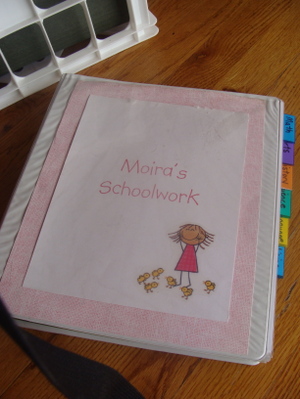
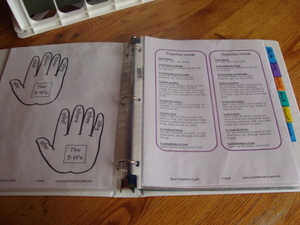
First, we set up a personalized binder with colored pocket dividers for each major subject – math, religion, language, history, science, and the arts. The week’s work is placed in the front pocket of each divider. For consumable books this is as simple as tearing out the pages. For notebook entry type work we fill the pocket with cardstock paper. For reading work or learning station work we have cards with a number of assigned pages or an icon of that learning center on them. When they do that activity they move the card to the back pocket.
We don’t schedule which things must be done which days. There are a number of reasons for this (more on this in the next post). First, few days and weeks are ever completely the same. Even when we do not plan for this to be the case, children have a maddening habit of unpredictably puking, wheezing, breaking things, getting colic, seeing the dentist, being born, you name it. This over and above the regularity of salad dressing spilling in the fridge and toilets backing up and repairmen who can only come at certain times. These things tend to interrupt the best schedules. If your day is too compartmentalized you find yourself regularly disappointed and discouraged when these things happen. And they will. More than you can ever foresee!
If that mythical perfectly pre-planned day is apt to appear so rarely then it is a waste of your energy to put all your planning eggs in that basket. If, instead, you have floating times and materials these things won’t derail your day, at least not most of the time. No one is waiting on you for the next direction. There is no fretting when the time slot for history is shot for the day. Things can flex. They must and not just for your sake but for the children’s. We are educating for a lifetime. That life will no doubt be every bit as complex and imperfect as our own. It is a disservice to lead them to believe that they can only complete a task well under a set of specific circumstances over which they will not likely be able to exercise complete control.
So the need for flexibility the first reason. The second is to help facilitate self-pacing, responsibility, and good time management. It is important for children to take ownership of their learning. You have presumably already been through grade school (or high school) etc. It is they who have the most vested interest in this learning venture. It is their education. While we do our darnedest to guide, support, and encourage, we cannot learn for them. In the real world they will have to manage their time and their activities. This is a good place to start. The binder gives them freedom within limits. They can choose which subjects to do first, whether to do a bit of everything each day or to dive into one subject until it is complete and then move to the next. Those are personal preferences we can accommodate.
Additionally, each binder has a mini-office in page protectors. These are pages of basics to be mastered at a given grade level such as phonograms, math facts, money denominations, writing/editing guidelines and other memory work. The poems and prayers we are working on are included and copies of the term’s art appreciation pics. This provides automatic review each time the binder is opened. It also means that a child can grab his binder and pull up a stool while mom is cooking or curl up on the couch while a baby is nursed and easily go over memory work and drills. It means an older child or Dad can easily tutor. It means you have a portable school desk that travels well to appts and piano lessons. It means guerilla homeschooling at its best.
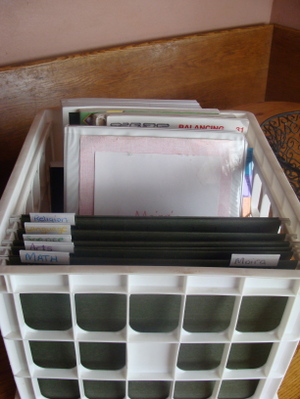
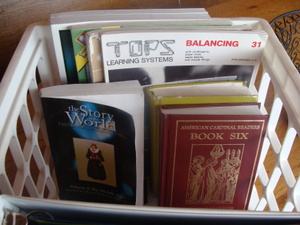
By the end of the week the completed work is evaluated and filed into the student’s crate. The crate contains hanging files labeled with the same colors as the binder dividers. There are also extra files for each child of notebooking paper, homeschool documents (notification copies, attendence, course of study, lists of books read, etc) and the books they are using as well as a box of pencils and art supplies. The straight line filing keeps it streamlined.
Alannah’s crate is set up just slightly differently. She is enrolled with American School like her brother. The program is self-paced versus scheduled by grade levels so we have one file for each course she must complete for the diploma. She will keep the crate for her whole high school career. If you had a more conventional freshman/sophomore/junior/senior arrangement you could simply add a right hand tab to the first file of the next set of grade level course files. Keep an additional file for tracking extra curricular activities and standardized tests if you do these. We add a file to track her extra reading since we painlessly round out the boxed curriculum that way. This makes for a running transcript, avoiding a last minute scramble.
This system accomplishes a number of our goals. First, everything each child needs is ready to go. No hunting for books or pencils. Second, everyone knows what is expected when the week starts. For some reason this seems to be a HUGE drive for many kids. While they may enjoy project work or whatnot most seem to want to be able to see what the big picture is and make a mental picture of their week. My husband also wanted to have that big picture and to be able to quickly ascertain what each child had done daily without it becoming a major nightly ordeal of dragging out a number of notebooks, workbooks, etc for each child. Finally, it meets another family goal which is easy record keeping. The crates are definitely that! At your fingers is a full inventory of the year’s work to date. Heaven forbid, if mom should suddenly be out of commission, Dad can produce whatever is necessary on a moment’s notice.
Like I said, it is certainly not the only way to do things. It is however, the simplest we have found. After a fairly speedy setup you are good to go and not tied to plan books nor daily/weekly computer record reports. It allows for a rich, yet low-maintenance education. The lion’s share of your time is spent on learning, as it should be, not on logistics.
Next up: Rhythm. What does that really mean and how does that factor into our life?



 Starry Sky Journal