"How many of them are boys?" People usually want to know when they discover that we have ten children. How many of those children are boy children? Because the higher that particular number is the louder the gasps as a rule. "Six boys? Wow. You must be a saint." I assure you, as can those six, that I am not. However I might suggest there is such a saint we might want to try to emulate in this case: John Bosco. He knows boys. I might be juggling six strapping young men. He cared for hundreds with one devoted woman, his mother. If they could do so well, surely we can do this too.
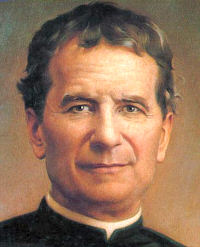
John Bosco was fatherless himself, having been raised by a widow. He took pity on the street urchins of his day, looked upon with judgement and disgust, kicked to the curb and urged on and away like so many stray dogs. He rejected the idea that genetics dictates character. He sensed that coercion and harsh discipline only bred bitterness and rebellion. He set about to test his theory that change is possible once you gain the affection and respect of your charges. In fact, he was pretty sure that was the only way.
Turns out he was right.
Boys flocked to his oratory which mushroomed quickly and grew into multiple homes and schools which continue to this day to employ his 'preventative system'. What is that you ask? Well it is directly opposed to the repressive system prevalent in his day and we could argue, still in pretty regular use.
"The repressive system consists in making the law known to the subjects, and afterwards watching to discover the transgressors of these laws and inflicting, when necessary, the punishment deserved….
Quite different from this and I might even say opposed to it, is the preventive system. It consists in making regulations known, and then watching carefully so that the pupils may at all times be under the vigilant eye of the Rector or the assistants, who like loving fathers can converse with them, take the lead in every movement and in a kindly way give advice and correction; in other words, this system places the pupils in the impossibility of committing faults."
Like the Montessori system he allowed freedom within limits. "Do anything you like, just do not sin." And he meant it. He knew boys needed to run and jump and whoop and holler. His was not a somber school. He learned to juggle and do gymnastics. Anything to capture their attention and win their hearts. Teachers were urged to enter into those childish pastimes, "like what the boys like, and the boys will come to like what the superiors like." They were to take the time to truly know the boys and learn their games, participate.
They were most importantly to be present. He took to heart the proverb which reminds us that children left to themselves bring shame upon their mothers – and fathers of course. To that end, those in charge of children were to be observant, to enter into their play and their work. To come up alongside versus direct from afar. To set them up for success.
Do we do that? Are we present throughout the whole day? Are they right alongside of us cooking, washing, reading, shopping, gardening. Or do we send children to make their beds or brush their teeth or give a general direction to "clean your room" while we take a phone call or check mail or watch a tv program and then rail and fuss later when those things are poorly done? Do we send them off to play unsupervised and then regretfully discover they have picked up bad language or habits?
John Bosco exhorts us instead to love and participate genuinely and to be genuinely invested. He urges us to avoid at all costs "cold legislation". His dying request was this:
Do you know what this old man who has spent his life for his dear boys, wants from you?
(to return to) the days of affability and mutual forbearance for the love of Jesus Christ; the days when hearts were open in all simplicity and candour, the days of charity and true happiness for all.
Only then could they hope to communicate the truths of the Faith, and a moral and practical education. That is the only way we can hope to do it as well.
If there is a secret to raising boys – to raising all children – I think it is this. We must enter into their lives, love their loves, understand their dreams. We must guard their hearts and minds and be vigilant about outside influences. Garbage in, garbage out. We must respect them as children of God as well of ourselves. We have to stay on the same team ultimately.
This is the way of peace in the home.
These are my thoughts at the end of this feast day.
If you'd like to learn more about the prevantative system you can read
here and
here and
here. We are watching
this movie together this week.
A short play for children to perform
here

 Starry Sky Journal