Patience and Time

My few years hanging out with Leo have come to a close. I wrapped up my long, drawn out War and Peace project last night.  Honestly I don’t even know how I feel about it.  Tolstoy famously quips that pure, unadulterated sorrow is as impossible as pure, unadulterated joy.  In the same way I can say I feel great kinship with Tolstoy, his ideas, and his characters today.  I also can say the man’s pedantic, fatalist rambling  made me sometimes want to pull my own hair out.  There was a lot of that.  Still I read.

And read.

And read.

At times completely enthralled and other times not even sure why I kept trudging on besides the fact I felt deeply connected to the people and committed to seeing it through. 

I ended up seeing through War and Peace, Anna Karenina, Resurrection, and The Death of Ivan Ilyich and am now applauding myself enthusiastically because first, I am not that smart and second, my attention span is about as impressive as my energy level as a rule. It was a goal set and met though – despite all that life threw at me during the project – and that is worth noting with satisfaction.  

It is both sad to finally be walking away from these people and places and exciting to consider where to go next. My plan is to read a few of the boys’ high school lit novels which I have not yet read so we can hash those out better.  Sometimes I read ahead of them, sometimes I read aloud to them, and sometimes they summarize what they are reading.  It makes for a family book club of sorts. 

Years ago I was inspired by Joyce Swan working through her oldest’s assignments each evening so she could teach and troubleshoot more effectively.  Constant relocation and many years of night nursing prevented me from doing this as well as I had hoped.  There are still children to teach however, and if I can’t get to all the work ahead of them it is still helpful to do what I can.  Reading is a wonderful way to come together with your big people no matter where they spend their days.  It will be good to reconnect in this way. 

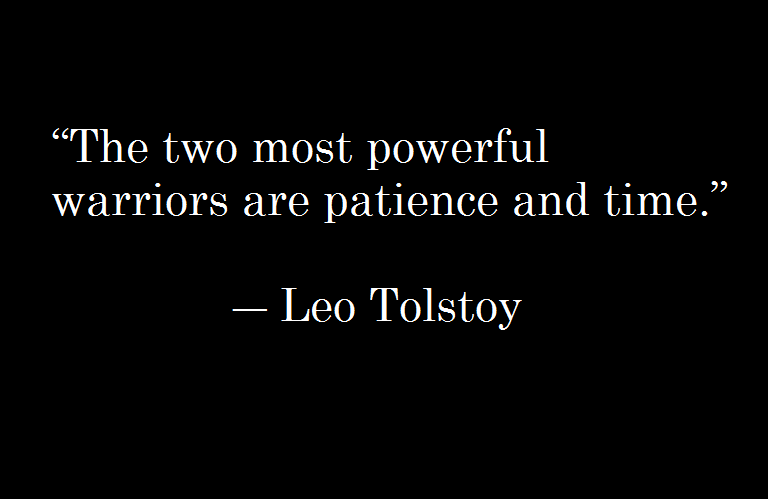
Tolstoy advises: A man on a thousand mile walk has to forget his goal and say to himself every morning, 'Today I'm going to cover twenty-five miles and then rest up and sleep.”

And so it is here. I’ve tried not to look at the whole journey and just tackle each day’s leg of it.  If I fell a bit short sometimes, I went a little further the next day. This is the way we chip away at the classics.  Eventually you look up and an epic work is under your belt.  

8B7DD4E5-66EE-4926-B54D-6908283C2307

What’s Important Now

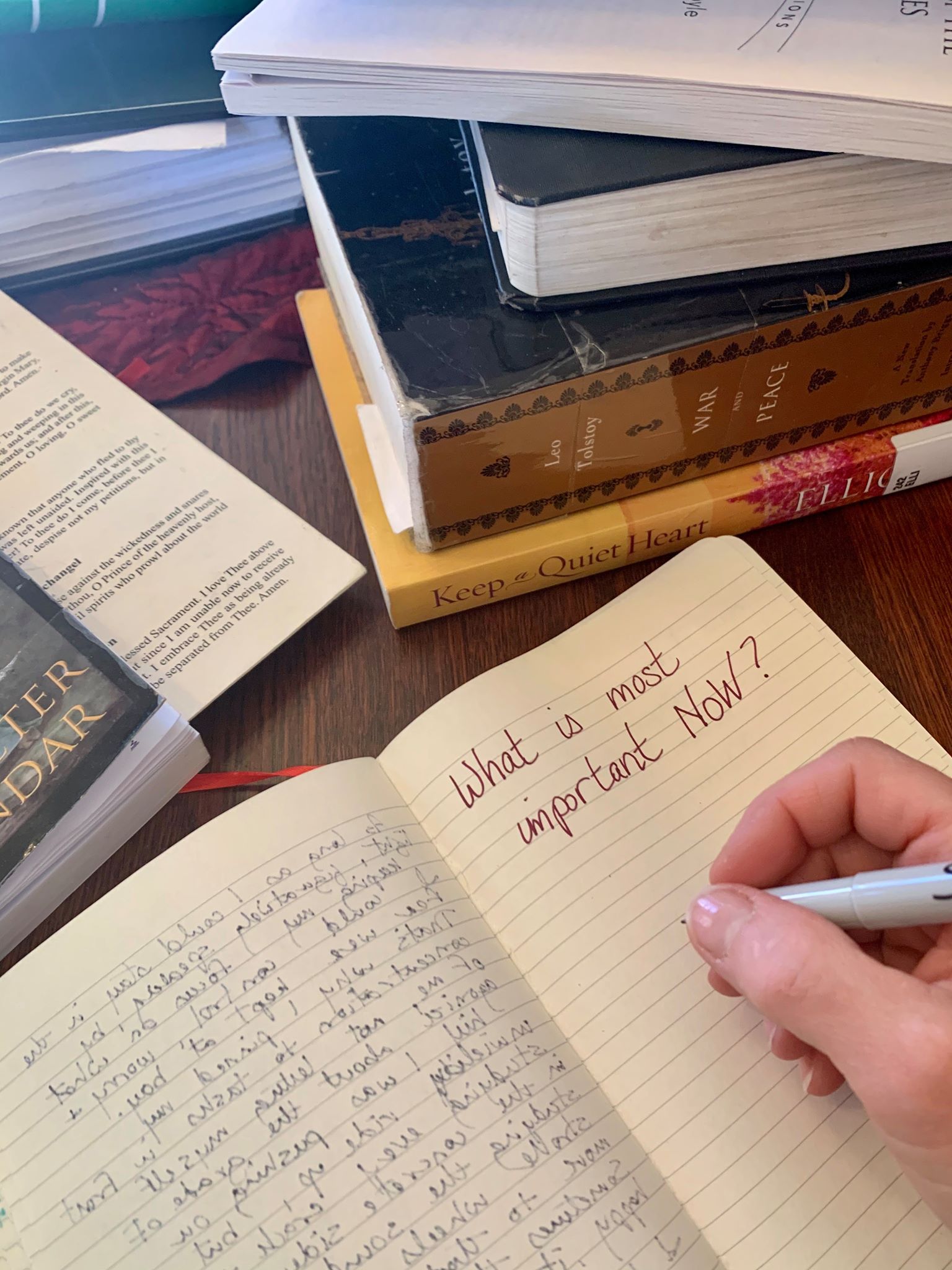
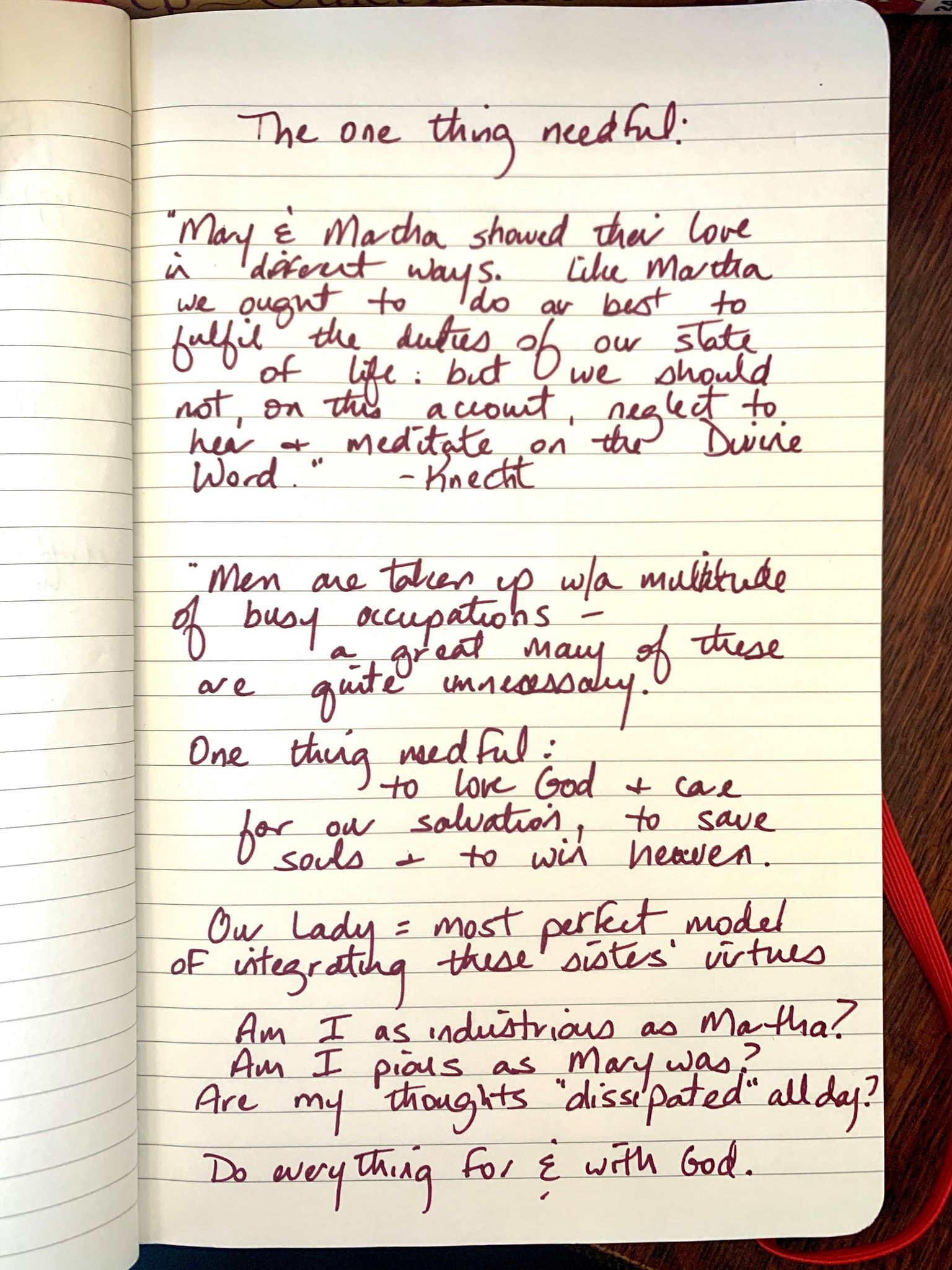
Tess read the story of Martha and Mary for bible study this week.  I try to base my own reading and journaling around what the children are studying, both to be efficient with my time and to help them flesh out what they are learning. Knecht's Practical Commentary on Holy Scripture has been such a treasure in this regard.  So wonderful! The practical application questions are challenging. 

Today's reading notes are from both this short study and an essay I read on Essentialism (do click through to her thoughts) based on this book. The premise is that we often experience great temptation to sample all the good things and experiences we hear about and as a result we spread our efforts so thin that we make little impact in any of those areas.  Instead we are encouraged to consider what is truly essential in our lives, our days, our vocations.  Do those well – Multum Non Multa. 

To discern what is essential at any given moment Lou Holtz, Notre Dame football coach, says to ask ourselves:

WIN

The acronymn obviously is WIN.  What's Important Now?  It may be most important that we stop procrastinating and finish our chores or prep for the morning.  It might be most important at a given moment that we set aside our work and listen intently to a small person with big things to say.  It might be important to go outside or say our prayers or make a call. There is no right answer for each person or each moment.  That's all discernment. 

 Knecht's commentary echoes this thought.  Instead of a pat answer, he urges us towards integration of corporal and spiritual works.  Work and rest. Martha and Mary – who both loved the Lord tremendously. 

Journal

The dissipation question was convicting and a big focus point for this year. I like to think big thoughts.  Too often they are lost in my head because the thinking is often more appealing than doing.  Big thoughts can disintegrate into daydreams, a little of which is delightful but too many, left unchecked, lead to that dissipation, a frittering away of our energy. 

Solution?  Back to that buzzword – What's Important Now – which ought to lead us towards doing the next right thing and the next. 

The Saint and the Merchant

Two stories have occupied my thoughts this week.  The first came during our morning time reading in Character Calendar about St Lucian, whose scriptural expertise paved the way for St. Jerome to produce the latin Vulgate.  He 'labored abundantly for the edification of others, but could not prevent being sometimes judged and despised by others," reads his biography.  The author goes on to explain that history has largely forgtten St Lucian and given St.Jerome the credit for the Vulgate we have today. We were challenged in the day's reading to ask ourselves if it bothers us when others are credited for hard work we have done or made possible. 

A different spin on that question came in the form of a story told around the prison camp fire by the peasant Karataev in War and Peace. The old man, a gentle, working class philospher told the story,

"…of an old merchant who lived a good and God-fearing life with his family, and who went once to the Nizhni fair with a companion- a rich merchant.

Having put up at an inn they both went to sleep, and next morning his companion was found robbed and with his throat cut. A bloodstained knife was found under the old merchant's pillow. He was tried, knouted, and his nostrils having been torn off, "all in due form" as Karataev put it, he was sent to hard labor in Siberia.

"And so, brother" (it was at this point that Pierre came up), "ten years or more passed by. The old man was living as a convict, submitting as he should and doing no wrong. Only he prayed to God for death. Well, one night the convicts were gathered just as we are, with the old man among them. And they began telling what each was suffering for, and how they had sinned against God. One told how he had taken a life, another had taken two, a third had set a house on fire, while another had simply been a vagrant and had done nothing. So they asked the old man: 'What are you being punished for, grandfather?'- 'I, my dear brothers,' said he, 'am being punished for my own and other men's sins. But I have not killed anyone or taken anything that was not mine, but have only helped my poorer brothers. I was a merchant, my dear brothers, and had much property. 'And he went on to tell them all about it in due order. 'I don't grieve for myself,' he says, 'God, it seems, has chastened me. Only I am sorry for my old wife and the children,' and the old man began to weep.

Now it happened that in the group was the very man who had killed the other merchant. 'Where did it happen, Daddy?' he said. 'When, and in what month?' He asked all about it and his heart began to ache. So he comes up to the old man like this, and falls down at his feet! 'You are perishing because of me, Daddy,' he says. 'It's quite true, lads, that this man,' he says, 'is being tortured innocently and for nothing! I,' he says, 'did that deed, and I put the knife under your head while you were asleep. Forgive me, grandfather,' he says, 'for Christ's sake!'

Karataev paused, smiling joyously as he gazed into the fire, and he drew the logs together.

"And the old man said, 'God will forgive you, we are all sinners in His sight. I suffer for my own sins,' and he wept bitter tears. Well, and what do you think, dear friends?" Karataev continued, his face brightening more and more with a rapturous smile as if what he now had to tell contained the chief charm and the whole meaning of his story: "What do you think, dear fellows? That murderer confessed to the authorities. 'I have taken six lives,' he says (he was a great sinner), 'but what I am most sorry for is this old man. Don't let him suffer because of me.' So he confessed and it was all written down and the papers sent off in due form. The place was a long way off, and while they were judging, what with one thing and another, filling in the papers all in due form- the authorities I mean- time passed. The affair reached the Tsar. After a while the Tsar's decree came: to set the merchant free and give him a compensation that had been awarded. The paper arrived and they began to look for the old man. 'Where is the old man who has been suffering innocently and in vain? A paper has come from the Tsar!' so they began looking for him," here Karataev's lower jaw trembled, "but God had already forgiven him- he was dead! That's how it was, dear fellows!" Karataev concluded and sat for a long time silent, gazing before him with a smile."

Teresa of Avila and other Carmelites have written extensively about unjust accusations, insisting odds are that we have also had good attributed to us which we did not merit.  Further, if we are being unjustly criticized it is also often true that we are guilty of other wrongs which have mercifully gone unnoticed. 

These have been challenging concepts for me. I am a melancholic by nature, keenly – often, overly – focused on justice.  As is so often the case, God's ways are not ours however, and we rarely consider things from as many angles as we ought.   The old man, without in any way approving of man's wrongdoing,  knew all things went through God's hands first. The court had sentenced him falsely, but he was in truth, convicted by his own personal sins.  He knew his fate was not actually in the hands of men, but ultimately of God.  A more perfect trust in Divine Providence would be hard to imagine. Likewise we are assured St Lucian was quite content knowing God was aware of his efforts in this world and that any accolades accrued here are worthless in comparison to those in the next.   

It all comes out in the wash is the gist.  Easier said than done, no doubt. I am grateful for the inspiring examples literature and history provide. We are encouraged to focus more on how our things look in the eyes of eternity than on the approval or condemnation of our contemporaries, whose judgement can never be omnipotent. 


Platon Karataev & Pierre Bezukhov


On Educational Foundations

Hillsdale College's excellent Imprimis newsletter arrived this week. Larry Arnn wrote a superb essay on the four pillars of education upon which the college was founded: learning, character, faith, and freedom.  There are many takeaways for the classically inclined educator.  In speaking of the college's founders he says they believed:

Liberal education is the road to good living, good citizenship, and good statesmanship.

College is about thinking, and the refinement and informing of the intellect is its first purpose. This requires in turn the education of the whole human being.

Doing and thinking work together to form character. If character is not courageous, moderate, and just, then not only will (students) be craven in action, but thinking will be impaired.

All of our judgments of good and bad, better and worse, implies some standard that is complete or perfect.

It is better to inspire allegience to a cause than to self and that is most effectively done through beautiful language.

Things that have been thought good for a long time are worthy of our attention, respect, and study.

He goes to discuss permanence, change, and forms of government so eloquently I will not attempt to sum up but rather will share the link to the essay here if you'd like a short but compelling read to mull over.  


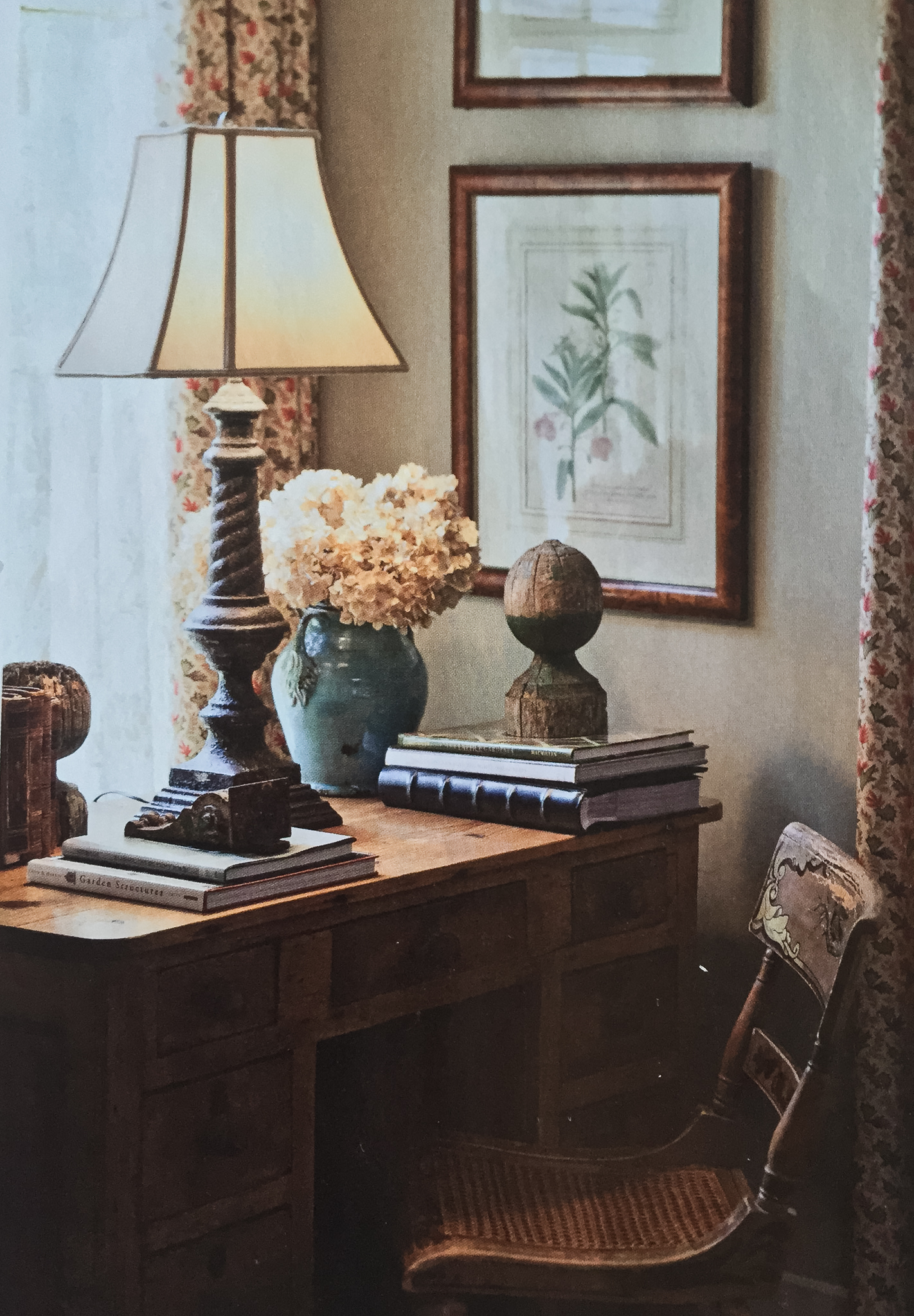
Desk  (1 of 1)

note: I will add the disclaimer that I do not think these principles apply only to the college environment nor do I specifically endorse a particular institution.  

Goals

It could not be more cliche to discuss goal setting the first week in January.  Here I am though, because one of those goals was to document more consistently.  2019 was a move year.  We began in one house, ended in another, and had a few short stays in between. We were so very happy to be near our children and old friends. We were also anxious to get the children settled.  For this reason, the house was quickly set to basic order and we jumped right into living.  In some ways that was a blessing.  There was time to see how the spaces needed to work. There was time to see how our new schedule played out.  

Busy.  That's the best way to describe the past year.  And new.  Everything new.  

New house.

New school programs

New neighbors

New puppy

New health challenges (Ahem, hello middle aged shenanigans. Is it warm in here or is it just me?)

New schedules

New climate/weather patterns (rain, rain, then snow, snow)

It's been dizzying and wonderful in so many ways but there were important adjustments to be made and habits to regain. So here we are.  Some 2020 notes I have roughed in so far:

Health: 

Cut carbs back to just fresh fruit

30 minutes a day out with the dogs

Stretch/strength routine regularly

Supplements organized

Prayer:

Mother Love morning devotions

Rosary and St Michael chaplet

Print liturgical calendar

Rotate seasonal and saints info in kitchen frames

Mother Culture:

Finish Tolstoy and begin shorter works

30 minutes daily reading

Scrapbooking/Studio time

Puppy class

House:

Set up command center/launch pad

Revamp pantry

Refloor basement

Most are underway now. Idle scrolling has been one of the little foxes that can spoil the vineyard.  It's a fine balance because I do also get tremendously inspired online.  I tend to be able to discern when I am no longer inspired or acquiring info and when I am procrastinating though and am working hard to shut the latter down.  


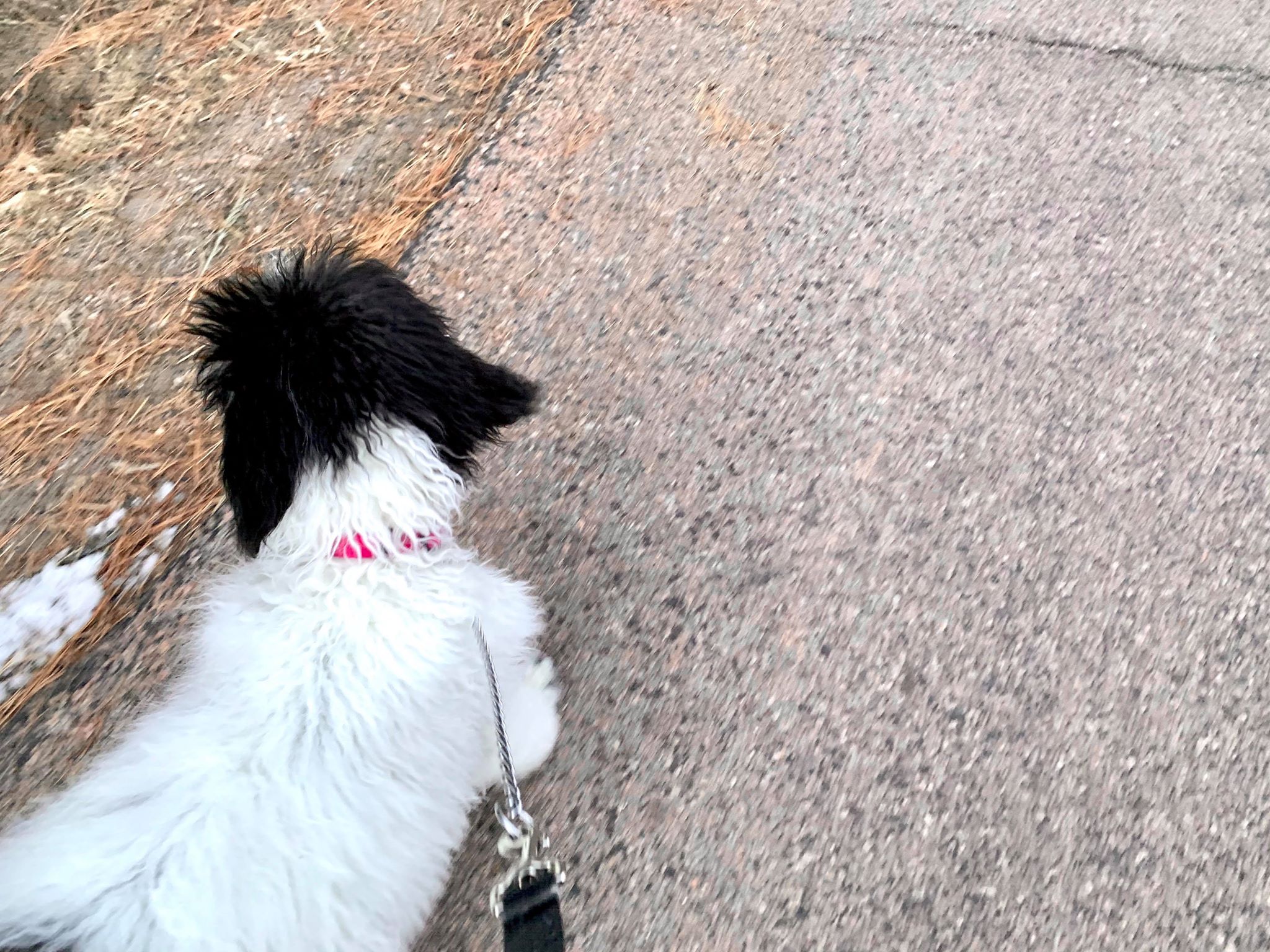
I will share more about our newest addition, a standard poodle puppy.  Let me just say here that while it was entirely insane for so many reasons, she is keeping me focused and moving and outside daily.  She is doing the same for our older buddy Archie the poodle as well.  Jefferson said, 

Walking is the best possible exercise.  Habituate yourself to walk very far.

Castle walk

It's likely that Jefferson had a more ambitious estimation of "far" but I am trying and the dogs are grateful.  It is truly the habit and not the action that is the challenge.  There is always a good reaon to put things off.  In the end its the habits that make the difference.  If you don't have a copy, a favorite resource is Laying Down the Rails from Simply Charlotte Mason.  I have read it over and over and am always inspired.  The best takeaway was to start with one good thing.  

Just keep doing it.  

Walking was my one thing to start being consistent with this year, for myself and my dogs.


An Epiphany

N1639747

"Why do I share this?" 

A dear friend added this line by way of explanation when she had shared her truly lovely January mantle decor. I understand why she may have felt the need to justify sharing it at all.  Many voices over the years have attributed various self-congratulatory motives to those who share online.  For all I know there are cases where those may apply. Certainly that is not true for all artists and authors through time, however.  As I have been gathering and returning some old favorites into my regular rotation lately, I have considered the impact their words and images have had on me and my own motivation for sharing.  

Why do I share? 

I share because the reflections shared by older women inspired me so very much when I was first making a home and raising a family. They were a gentle means of accumulating little bits of art, history, and philosophy in bite-sized bits – which was all I could manage in busy seasons.  Strung together they resulted in an education for which I am eternally grateful in our era of strict, functional practicality.

I share because I have come to believe that beauty is not simply the dessert or worse, the junk food of life. It is vital sustenance which nourishes and builds our strength and vision. We should consider it a foundational building block rather than an indulgence.

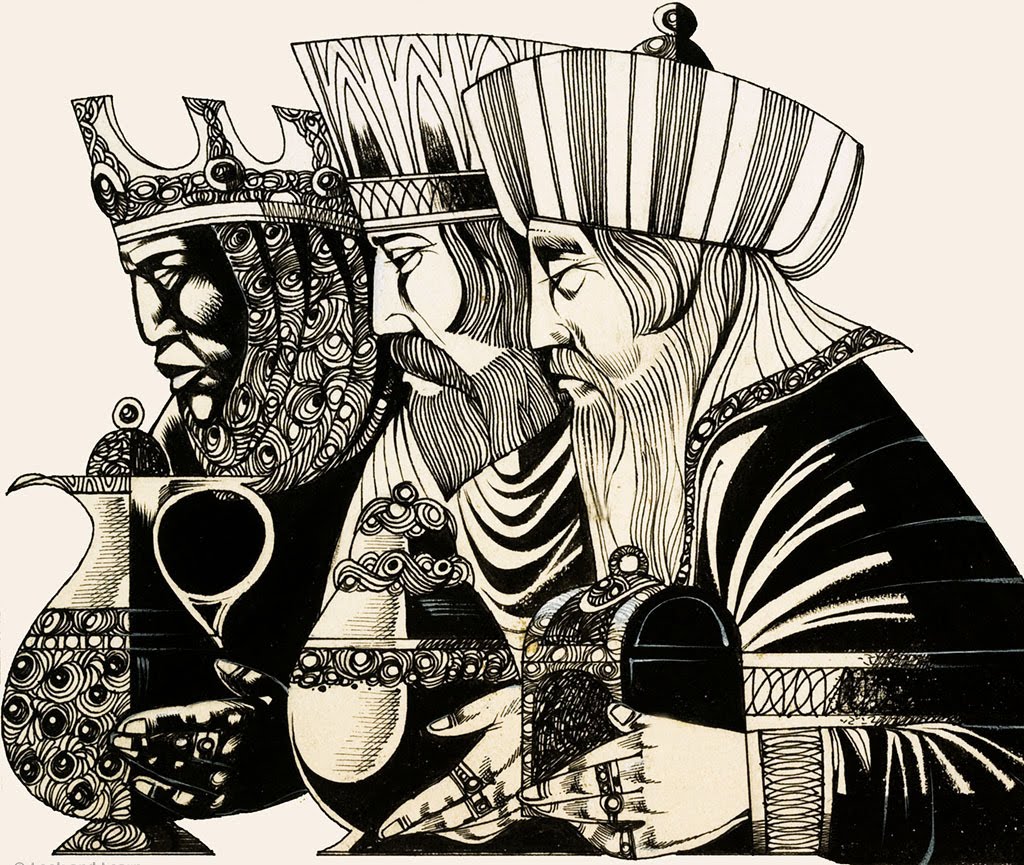
I share because the first and most natural response the Magi had upon learning of a young mother with a blessed child was to share their gifts. They went to great lengths to bring beautifully bright, precious, and sacred things, riches full of symbolism and layers of meaning. They were gifts that touched the senses.  We can imagine some then, too, scorned these as impractical and unnecessary.  

We need both Martha and Mary, practicality and vision, to be productive and contemplative. We need feel no guilt over encouraging both and bringing a little ray of light into someone else's day.  As another friend shared, beauty is not like a cake where your large slice diminishes the amount left for others.  It is a candle which can ignite those nearby.  I am so grateful for the women who have shared their gifts so generously and helped me to likewise brighten my own little world. 

James 1 17