
A Rich Harvest

Kenny hill farm book (47 of 120)

This week has been full of challenges.  This isn't particularly out of the ordinary in a large family mind you.  I was grateful to awaken fairly rested this morning and had an hour to myself to sit and read and think in absolute quiet before I needed to shift into high gear. A title caught my eye on the bookshelf: Holy Abandonment.  My fingers ran down the table of contents til they reached "home and community." 

The page found, I read first, "Our time on earth is a a time of conflict: of conflict against ourselves to repair our faults, to overcome our defects, and to grow in virtue and merit. The means at our disposal for attaining these ends are manifold. One of the most efficacious is community life with the sacrifices it imposes."  This of course, has its counterpart in the domestic church, the home and family. 

Jean Pierre de Caussade writes that, "…because you have not sufficiently brought home to yourself this great principle, you have never been able to submit as you should to certain conditions and occurrences, nor consequently to remain firmly and tranquilly united to the will of God." He says we suffer much disquiet and 'false reasonings' on this account. 

There is a section which follows that explains that the irritations and upset we experience with others only serves to show us what is inside of ourselves.  Kind of like that meme about how when the kettle is knocked you find out what was boiling inside of it.  Other people serve to reveal was already inside of us.  For this reason the author asserts that these occasions of annoyance are a blessing.  (otherwise) "We should imagine we knew ourselves and all the time entertain the most fantastic illusions, if this person or that in a moment of temper did not frankly tell us the truth about ourselves."

He shares that a holy founders once said, "Each of you has her own disposition, temper, imperfections, eccentricities. If we had no difficult characters (in our family/community) we would be obliged to purchase some in order that they might help us to heaven. God has provided us with such means free of charge. It is for us to make the most of of this means of mortification."  

Digest that one for a moment.  These personality clashes are somehow a blessing.  More than that,  a necessity.

Holy Abandonment advises:

"Let us forgive and we shall be forgiven. Let us forget the wrongs we have suffered from our brother and God will gladly forget the wrongs He has suffered from us. Let us support our neighbor, let us be patient with him, show him mercy and kindness; and the Lord, ever faithful to His promise, will deal in the same manner with us."   The author understands this is not easy.  "It costs something to suffer without respite." 

These contradictions which we face day in and day out, "Provide us with repeated opportunities for the practice of the rarest and most solid virtues: charity, patience, gentleness, humility of heart, kindness, mortification of the temper, etc.  These little daily virtues, faithfully practiced, will yield us a a rich harvest of graces….

This cross alone (daily irritations) will serve more effectually than other crosses, heavier in appearance."

De Caussade goes so far as to say, "Far from pitying you, I can only congratulate you on having found at last an occasion for the practice of true charity. The antipathy you feel for the person with whom you are continually associated,  the opposition between your ideas and temperaments, the pain he causes you by his manners and language are so many infallible guarantees that the charity you will exercise in his regard shall be purely supernatural without the least alloy of human sentiment. Therefore thank the good God."

He gives four instructions so we may not squander this opportunity:


  1. Endure patiently the involuntary feelings of resentment excited in your heart by the conduct of this person, just as you would endure an attack of fever or a headache. 
  2. Never speak as perhaps others do of this person but always say something to his advantage for he must have some good qualities. And which of us is altogether free of defects?
  3. Whenever you commit any fault (ie respond undesirably to the person) repair it once by gently humbling yourself without any voluntary bitterness either against yourself or this person. By means of these daily miseries and faults God never ceases to lower our pride and keep us in true humility. 
  4. Abandon everything to Providence. 


"Instead of complaining, let us bless God Who has had the wisdom and the goodness to place at our side (such a person) for that neighbor is necessary to us."


St Jane Frances de Chantal, a woman who is said to have begun her life with a 'haughty' disposition, chipped away at her pride and grew in humility over a seven year span following her husbands untimely death. She was ill-treated and suffered humiliations in her father-in-law's home.  You can read more here on page 164-165. 


Overcoming Oneself

We made a short visit to the Western Slope to see one of our sons – and the fall colors – this weekend. My phone is also down so I missed my annual sharing of St. Francis' Perfect Joy.  I certainly thought about it though and am posting a bit late anyway.  It's too good to miss.  

HOW ST FRANCIS, WALKING ONE DAY WITH BROTHER LEO, EXPLAINED TO HIM WHAT THINGS ARE PERFECT JOY

One day in winter, as St Francis was going with Brother Leo from Perugia to St Mary of the Angels, and was suffering greatly from the cold, he called to Brother Leo, who was walking on before him, and said to him: “Brother Leo, if it were to please God that the Friars Minor should give, in all lands, a great example of holiness and edification, write down, and note carefully, that this would not be perfect joy.”

A little further on, St Francis called to him a second time: “O Brother Leo, if the Friars Minor were to make the lame to walk, if they should make straight the crooked, chase away demons, give sight to the blind, hearing to the deaf, speech to the dumb, and, what is even a far greater work, if they should raise the dead after four days, write that this would not be perfect joy.”

Shortly after, he cried out again: “O Brother Leo, if the Friars Minor knew all languages; if they were versed in all science; if they could explain all Scripture; if they had the gift of prophecy, and could reveal, not only all future things, but likewise the secrets of all consciences and all souls, write that this would not be perfect joy.”

After proceeding a few steps farther, he cried out again with a loud voice: “O Brother Leo, thou little lamb of God! if the Friars Minor could speak with the tongues of angels; if they could explain the course of the stars; if they knew the virtues of all plants; if all the treasures of the earth were revealed to them; if they were acquainted with the various qualities of all birds, of all fish, of all animals, of men, of trees, of stones, of roots, and of waters – write that this would not be perfect joy.”

Shortly after, he cried out again: “O Brother Leo, if the Friars Minor had the gift of preaching so as to convert all infidels to the faith of Christ, write that this would not be perfect joy.”

Now when this manner of discourse had lasted for the space of two miles, Brother Leo wondered much within himself; and, questioning the saint, he said: “Father, I pray thee teach me wherein is perfect joy.” St Francis answered: “If, when we shall arrive at St Mary of the Angels, all drenched with rain and trembling with cold, all covered with mud and exhausted from hunger; if, when we knock at the convent-gate, the porter should come angrily and ask us who we are; if, after we have told him, ‘We are two of the brethren’, he should answer angrily, ‘What ye say is not the truth; ye are but two impostors going about to deceive the world, and take away the alms of the poor; begone I say’; if then he refuse to open to us, and leave us outside, exposed to the snow and rain, suffering from cold and hunger till nightfall – then, if we accept such injustice, such cruelty and such contempt with patience, without being ruffled and without murmuring, believing with humility and charity that the porter really knows us, and that it is God who maketh him to speak thus against us, write down, O Brother Leo, that this is perfect joy.

And if we knock again, and the porter come out in anger to drive us away with oaths and blows, as if we were vile impostors, saying, ‘Begone, miserable robbers! to the hospital, for here you shall neither eat nor sleep!’ – and if we accept all this with patience, with joy, and with charity, O Brother Leo, write that this indeed is perfect joy.

And if, urged by cold and hunger, we knock again, calling to the porter and entreating him with many tears to open to us and give us shelter, for the love of God, and if he come out more angry than before, exclaiming, ‘These are but importunate rascals, I will deal with them as they deserve’; and taking a knotted stick, he seize us by the hood, throwing us on the ground, rolling us in the snow, and shall beat and wound us with the knots in the stick – if we bear all these injuries with patience and joy, thinking of the sufferings of our Blessed Lord, which we would share out of love for him, write, O Brother Leo, that here, finally, is perfect joy.

And now, brother, listen to the conclusion.

Above all the graces and all the gifts of the Holy Spirit which Christ grants to his friends, is the grace of overcoming oneself, and accepting willingly, out of love for Christ, all suffering, injury, discomfort and contempt;

…for in all other gifts of God we cannot glory, seeing they proceed not from ourselves but from God, according to the words of the Apostle, ‘What hast thou that thou hast not received from God? and if thou hast received it, why dost thou glory as if thou hadst not received it?’ But in the cross of tribulation and affliction we may glory, because, as the Apostle says again, ‘I will not glory save in the cross of our Lord Jesus Christ.’ Amen.”


Amen. I usually follow this up with an acknowledgement that this is why Christianity is such a tough sell.


October Binder

from the archives:


Friends know my deep, abiding love for Pinterest.  Let me tell how much easier homeschooling, homemaking, and all things creative are today!  I remember the tremendous struggle it once was having a list of poetry to memorize, for instance, and not being able to track down a particular piece in print.  Countless dead ends or false starts accrued simply because there was no way to access all the materials or patterns or whatnot.  My gratitude for the internet, generally, and Pinterest, specifically, is therefore profound.  So many resources right at your fingertips.  You have to be smart about how to gather and make use of them however. Good ideas you cannot quickly access will not likely be put to use.  It is wonderful to have it online but since we cannot and would never dream of doing all there is to do it helps to decide which of those fun things would make the most of our month and then start to plan. 

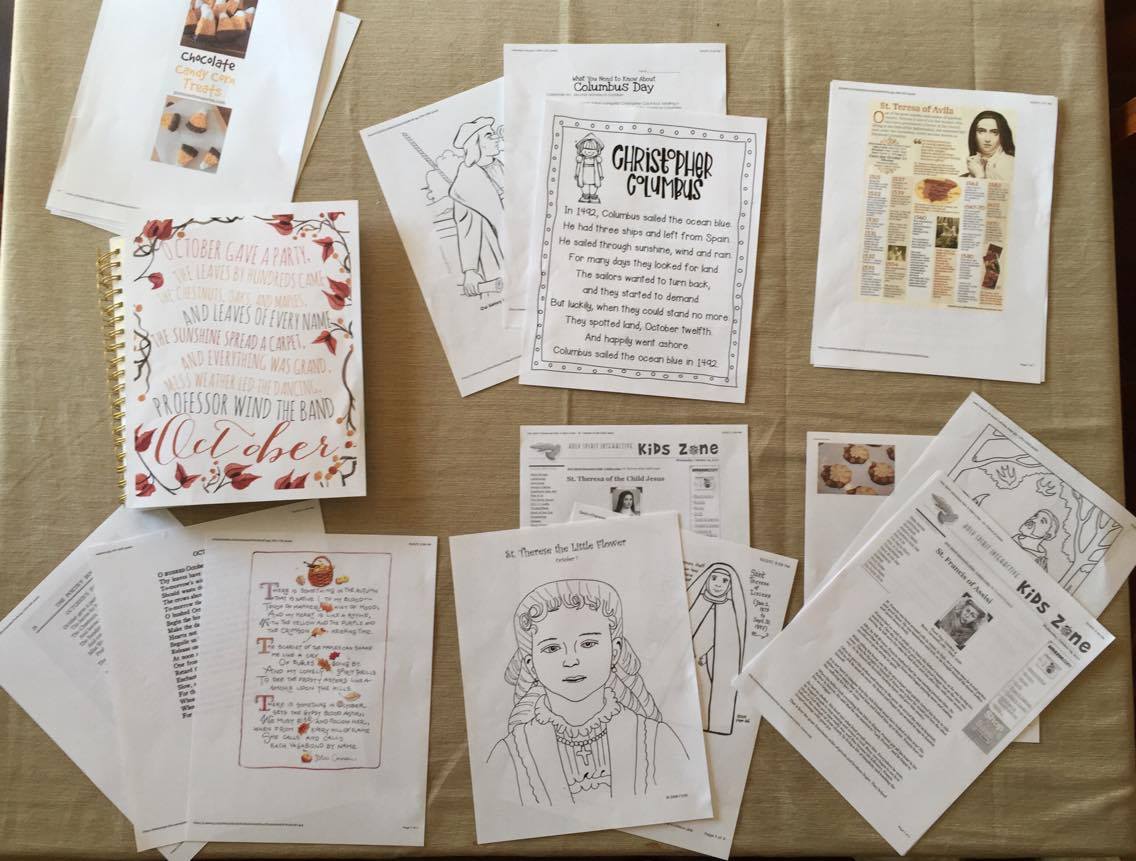
I am busy printing out pages and creating binders for each month so our lists are at the ready and can be slipped out when we run to the store or library.  Some of things included in our binders are:

recipes we plan to make

craft or decorating projects we hope to finish

books we will look for,

poems we will recite

hymns we will learn

seasonal worksheets 

coloring pages

quotes (seasonal or liturgical)

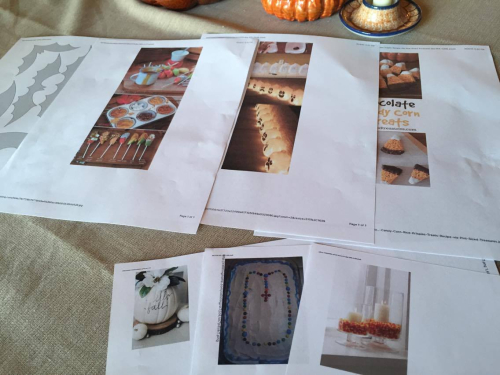
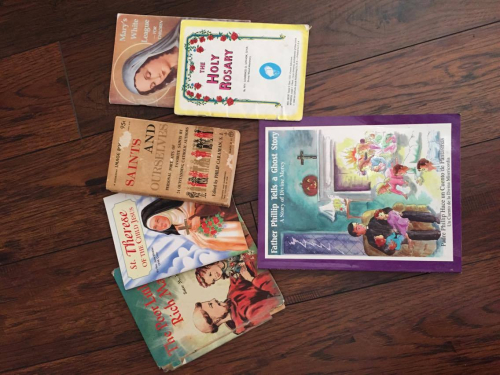
Before I put these in page protectors I snapped some photos of some of our October pages:

There are numerous links to free fall printables, so one of those will be the cover.

Oct8

Oct7

One or two crafty or food ideas for each week to include feast day desserts and a birthday cake and a gift. 

Oct7

The book basket is never exhaustive but rather just a smattering of titles pulled from our modest stash which will be supplemented by library books, ebooks, and online articles. 

Oct7
Oct7

Some links we are enjoying:

MP3 Catholic Kids Saints

St Francis animated video

St Francis bio and talk 

Vintage film St Francis 

St Therese film

Catholic/liturgical links

Seasonal decor ideas

If you keep seasonal binders, baskets or pin boards I would love to see them! 


My Guardian Dear

"He hath given his angels charge over thee; to keep thee in all thy ways." Psalm 90

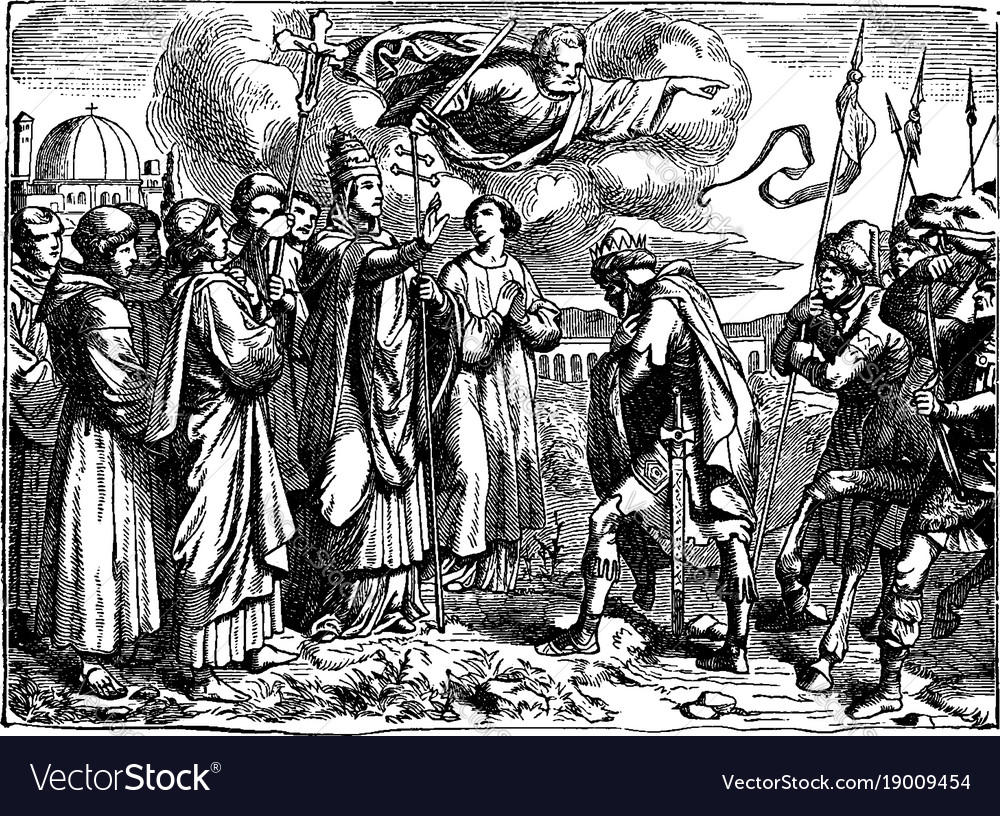
19009454

St Ambrose tells us, "Every soul at the moment it is infused into the body, is entrusted into the keeping of an Angel." 

"That there is an angel for each one of the faithful no one will contradict." St Basil

"Their angels always see the face of the Father," Mt 18:10

We have been told of the angels watching over us from the writers of the Old Testament up to the present day.  It is piously believed that countries, cities, churches and families have heavenly guardians as well. Despite the heartwarming depiction of Clarence in It's a Wonderful Life, angels are not wonderfully good people who go to heaven and get their wings.  Believers who go to heaven are referred to as saints – and not just the famous ones.  Angels were created ahead of us and are entirely different creatures of God.  And though they are also often depicted as chubby babies that isn't the best visual for creatures who have been seen defending us with flaming swords and on the front lines of battlefields. (more here)  Given how many accounts we have of angelic activity it ought to challenge any ideas we may have of the heavenly host lolling about on their own clouds. 

St Bernard admonishes us to continually bring to mind our indebtedness for this protection. "Never forget your life companion. Show him reverence for his presence, for his loyalty, and for his good will, and have great confidence in his protection."

Pius XI refers to St Bernard's instructions and adds to them:

"We wish to stress in particular as an act of gratitude that We have always experienced the wonderful help of Our Guardian Angel. We have often felt his very presence.

The same can be said of the Guardian Angels of all little children, that they are always present, led by their tender love to be ever watchful.

The conviction that we are protected by a prince of the heavenly army by one of those chosen spirits of whom Christ said that they always see the face of God, this conviction fills us with reverence, devotion, and a firm confidence.

Such a confidence is necessary and must give evidence of itself when a great duty must be fulfilled or a good resolution carried out. At these times we must avail ourselves of the help and protection of our Guardian Angel.

Our prayers for his help are the clearest and best expression of our confidence. This salutary thought of St. Bernard was impressed on our mind early in life by our mother, as soon as we were able to understand it.

This conviction supported us in all the things we have accomplished in our life with the help of God's grace, and it will certainly be our support in the remaining part of our life, which God will grant us."

Guardian Angel Protecting a Child from the Devil Painting by Bartolomeo  Gennari

We have a convicting example in St Francis de Sales.  Fr. Lasance relates:

St. Francis of Sales had a particular devotion to his Guardian Angel; he celebrated the Feast with special care and piety; in spirit he received his blessing in the most important actions of his life; and not only was he devout to his good Angel, but also to the Angels of his friends. He had even a devotion to those of the heretics, his enemies; for he said that in disputing with the Huguenots he exorcised the demons who possessed and obsessed them, and afterward invoked their Angels. When he was absent from his diocese, he recommended it in an especial manner to the care of his holy Angel. He never failed to salute the Angels of the kingdoms, provinces, or parishes which he entered. In the confessional he frequently invoked the Guardian Angel of his penitent, and we may read in his letters how much be recommended to his pious friends devotion to their Guardian Angel. He said that in this world the Angels attend to almost everything, as they are the messengers of God, and invisible; and that to accomplish much for His Divine service and not wish to appear was to serve God in an angelic manner.


Lest we think devotion to the angels is child's play, Father Husslein, S.J. says, "Never let us imagine we can outgrow in stature or in years, our need for the daily and more frequent recital of that perfect little prayer to the Guardian Angel which we learned at our mother's knee: 

"Angel of God, my Guardian dear,
To whom His love commits me here,
Ever this day be at my side,
To light and guard, to rule and guide."


A Prayer for October

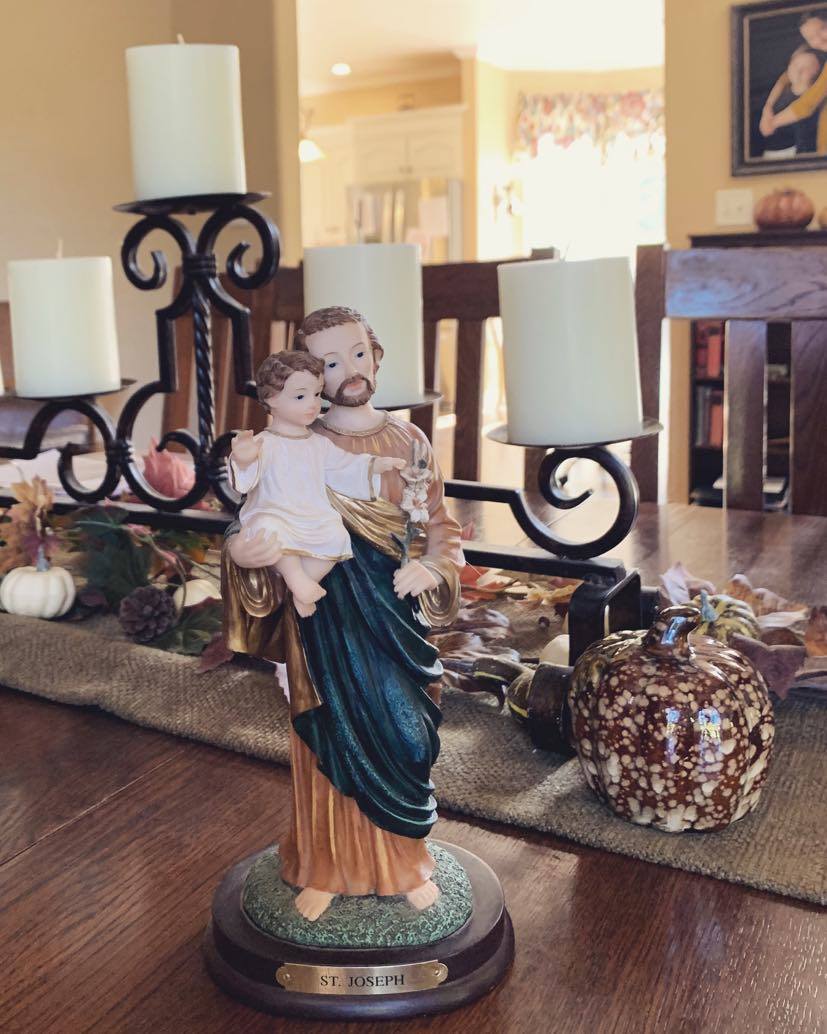
We learned something new in our adult class on the Faith last night.  We always do. We discussed Pope LeoXIII's Encyclical Quamquam Pluries, On Devotion to St Joseph.  It was written in 1889, but reading through it is apparent how applicable it is today.  I will just pull a couple excerpts:

"…you know the times in which we live; they are scarcely less deplorable for the Christian religion than the worst days, which in time past were most full of misery to the Church. We see faith, the root of all the Christian virtues, lessening in many souls; we see charity growing cold; the young generation daily growing in depravity of morals and views; the Church of Jesus Christ attacked on every side by open force or by craft; a relentless war waged against the Sovereign Pontiff; and the very foundations of religion undermined with a boldness which waxes daily in intensity. These things are, indeed, so much a matter of notoriety that it is needless for Us to expatiate on the depths to which society has sunk in these days, or on the designs which now agitate the minds of men."

He goes on to give some guidance especially for October, already consecrated to the Virgin Mary under the title of Our Lady of the Rosary.  St Joseph lived with Jesus and Our Lady for many years.  Their care and support was entrusted to him alone.

"…during the whole course of his life he fulfilled those charges and those duties.

He set himself to protect with a mighty love and a daily solicitude his spouse and the Divine Infant;

regularly by his work he earned what was necessary for the one and the other for nourishment and clothing;

he guarded from death the Child threatened by a monarch's jealousy, and found for Him a refuge;

in the miseries of the journey and in the bitternesses of exile he was ever the companion, the assistance, and the upholder of the Virgin and of Jesus."


He does on to explain why,"men of every rank and country should fly to the trust and guard of the blessed Joseph." He is the personification of paternal vigilance, the perfect example of love between spouses, protector of the vulnerable, who passed his own life in humble labor, content with slight possessions.  Next to Jesus and Our Lady, he is a most efficacious intercessor in Heaven for all families. For that reason the Holy Father made this request:  

"We prescribe that during the whole month of October, at the recitation of the Rosary, for which We have already legislated, a prayer to St. Joseph be added."

It is a small thing, a simple pious practice we can join to the daily rosary this month. The prayer he composed is here:

Prayer to Saint Joseph

To thee, O blessed Joseph, we have recourse in our affliction, and having implored the help of thy thrice holy Spouse, we now, with hearts filled with confidence, earnestly beg thee also to take us under thy protection. By that charity wherewith thou wert united to the Immaculate Virgin Mother of God, and by that fatherly love with which thou didst cherish the Child Jesus, we beseech thee and we humbly pray that thou wilt look down with gracious eye upon that inheritance which Jesus Christ purchased by His blood, and wilt succor us in our need by thy power and strength.

Defend, O most watchful guardian of the Holy Family, the chosen off-spring of Jesus Christ. Keep from us, O most loving Father, all blight of error and corruption. Aid us from on high, most valiant defender, in this conflict with the powers of darkness. And even as of old thou didst rescue the Child Jesus from the peril of His life, so now defend God's Holy Church from the snares of the enemy and from all adversity. Shield us ever under thy patronage, that, following thine example and strengthened by thy help, we may live a holy life, die a happy death, and attain to everlasting bliss in Heaven. Amen.

Joseph

Civil Discourse


120533381_2676503082610806_8249001269831147288_n
 
Like so many families we gathered to watch the debate last night. Like so many families – across the political spectrum – we are full of emotion and thoughts are swirling. What best summed up for me was this commentary:
 
“….what we saw on TV is exactly what is going on in our country. What they displayed last night was just a publicized, played-out version of what is happening on social media right now; people yelling at each other, talking past each other, cutting each other off…no one able to actually engage in a debate on the issues.
 
People are so firm in their stances that they can’t even speak respectfully to each other. We have lost respect for each other as humans. Yes, we should blame Trump and Biden (and Chris Wallace, too) for the display they put on last night.
But we should also be taking a good hard look at ourselves too, because…
 
this is exactly what many of us look like from the outside as well.
 
The debate was a sad reflection and representation of where our country is right now. We can do better, people.”  -Shanti Landon
 
There are any number of things about what unfolded last night that we can be outraged over. I won't point fingers, nor defend the indefensible.  I'd just say go ahead, vent those frustrations. When we are done, though, we need to take a step back and consider very honestly first, what we know about formal debate and second, how closely we follow those guidelines in our personal and social lives.
 
If our conversations, our posts, our memes were placed under the national spotlight how would we fare? How would our tone come across? Would our positions be compelling or off-putting? Do we generally engage or repel? Consider how we respond to criticism: Do we remain calm?
Resort to name calling?
Become defensive?
Turn the attack around?
Complain about problems or create solutions?
 
The Mother Love mass reflection reminds, “Has not a slight contradiction, the shadow of an insult, made me lose my self command and inspired me with thoughts of aversion?” 
 
I can answer that in the affirmative. Oh yes, I can. I bristle, y'all. Full of the Spirit one minute and full of spitfire the next. 
 
For school today we first discussed what civil discourse is – and is not – as outlined by American University here:
 
Civil Discourse is…
 
• Truthful
• Productive
• Audience-based
• About listening and talking
• Each Speaker's own responsibility
 
Civil Discourse is not…
 
• Mere politeness
• An exercise in martyrdom
• About telling other people who they are
• Purely performative
 
You begin to see the problem, don't you?
 
 
We then printed out some guidelines for civil discourse on the US Courts site here. These can and should be applied to a wide variety of interactions. We would be better for it personally and collectively.
 
I want to mention that I ran across a comment online this morning along the lines of 'desperate times call for desperate means.'
“We are in a battle and have no time/need to observe polite chit chat.”
Think about that.
Do we believe civility is merely desirable or obligatory? The answer is important. I’ll go ahead and play the WWJD card. I’m going to make the argument that even on the battlefield there are generally accepted rules of engagement. Even in wartime there are bounds to our behavior beyond which we harm our own character as well as our opponents.
 
The key virtue in fruitful debate is objectivity. You are debating the validity of ideas and actions, not the worth of persons. That last part ought to be a given. Our own egos ought to be so secure that we are able to separate ourselves and our emotions from the facts presented. This becomes more difficult when debate deteriorates.
 
No. 3128: Lincoln-Douglas Debates
 
Families and friendships are destroyed by our failure to observe these basics, though, so we will keep discussing over here. We will take this opportunity to check ourselves and keep striving to do better. To that end we will be working through the civil discourse lesson plans here We will go through the freebie here. Teachers Pay Teachers has some great graphic organizers here.  
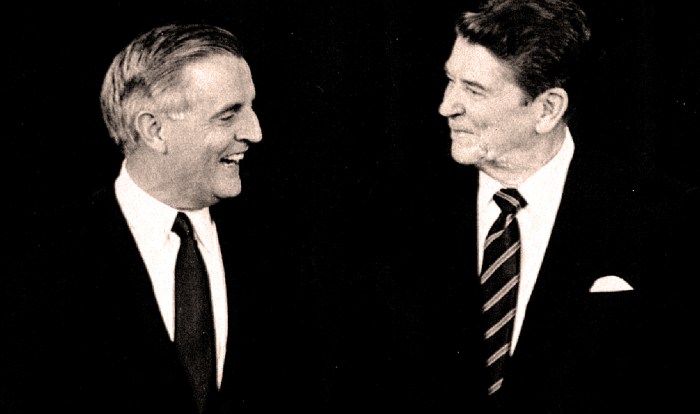
The Lincoln-Douglas Debates, which many students study in debate clubs, are worth a visit. (note: they had far more than two minutes to speak.) We will probably even check out some more contemporary debates such as the one between Reagan and Mondale.  (note: at the 26min point both candidates are asked to establish that they are "real" Christians and even challenged about missing church services.)  
 
Reagan-Mondale Debate No. 1
 
They are a serious palate cleanser and should serve to dispel any meritless comments like, "this is how it has always been," because it has not.  What has changed has changed in the second half of my lifetime and sadly, too many adults who grew up with better example are tossing it aside with abandon in their own discourse. 
Hopefully we will take the skills learned here in class out into the world and do better.
 
One conversation at a time.
 
Ultimately this is what we can control. We can make civility cool again.
 
No description available.