
To resume our history of the decline: the beginning of the end of the formal study of the Greeks arrived in the 1960's. Classics – lonely amo, amas, amat in the carrel, Demosthenes' hokey sermons on courage and sacrifice, Livy's advice to fight the good war – became worse than irrelevant. The entire package was viewed as part of the reactionary establishment. It had to be jettisoned. Classics was ancient, it was dominated by 'old' white males, it was time-consuming and difficult. So much page-turning, so many "no's" and "don'ts", and "stop-its." Absolutes, standards, memorization, and traditional values had no place on a campus where modernity, relevance, and ideology were the new mantras; to say as much publicly brought self-affirmation and a sense of revolutionary commitment.
University administrators caved in to the complaints of young often self-righteous students. Curricular 'reform' followed, resulting in the virtual abandonment of core courses – important, basic classes which required students to gain at least some familiarity with the literature, grammar, philosophy, history, and language of Classical study. (Even the Vatican gave in, dumping latin as the Church's universal language.) Professional 'educators' and social scientists leaped into the vacuum, spreading therapeutics through the university, metastasizing their "I'm growing" and "Tell us about yourself" like cancer cells in a weakened system. The seeds of the "feel-good" curriculum were planted, the crops of which we are harvesting in today's pressing concern for institutionally imposed self-esteem. This new, ultra-sensitive curriculum… ran directly counter to Greek wisdom.
Students of this new age, no longer either compelled to memorize irregular comparative adjectives or eager to soak up the corny wisdom of Sophoclean tragedy, now needed to be enticed back into the traditional classroom. Scholars were forced to win back their students and to convert the now preoccupied public to their own particular enclaves.
– Who Killed Homer? Victor Hanson and John Heath
An upside to moving an imposing volume of books all over the planet is to unearth hidden gems in your home library. I have acquired a good many more books than I've had time to read in the past couple decades. It is a great pleasure to dig into them now, with not much more time perhaps, but a somewhat clearer head. Sleeping through the night – at least more often – does that for you. ; D
I will confess I do not read latin and Greek in the original, however as the university went, so went the lower schools. The same fallout seems to have been experienced in trickle down fashion right through the grades which I do deal with daily. This book coincided with Colin, Alannah, and I watching Men Who Stare at Goats, which was equal parts hysterical and tragic to watch as a child of the 70's. They combined to leave me with a perpetual head shake and occasional grumble to myself this past week.
While the answer is not a joyless 'cracking down' I do feel that viewing absolutes and rigor differently is in order. Re-establishing a truth and rigor-based (versus an emotions-based) curriculum right here at home is a goal worthy of consideration lest we, too, find ourselves in a position of needing to entice our own students as we head 'back to school' shortly.
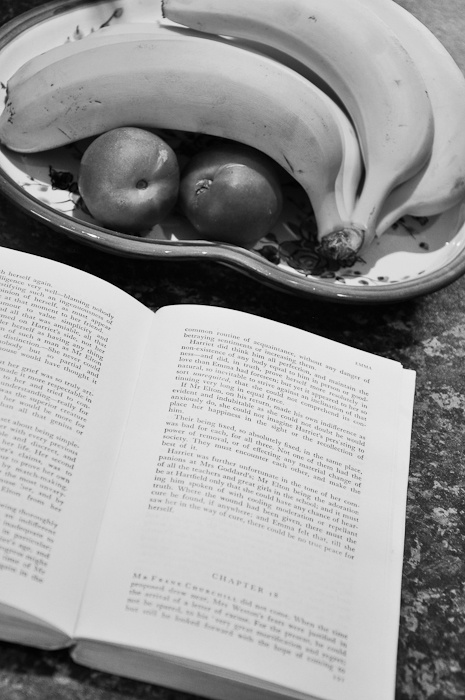
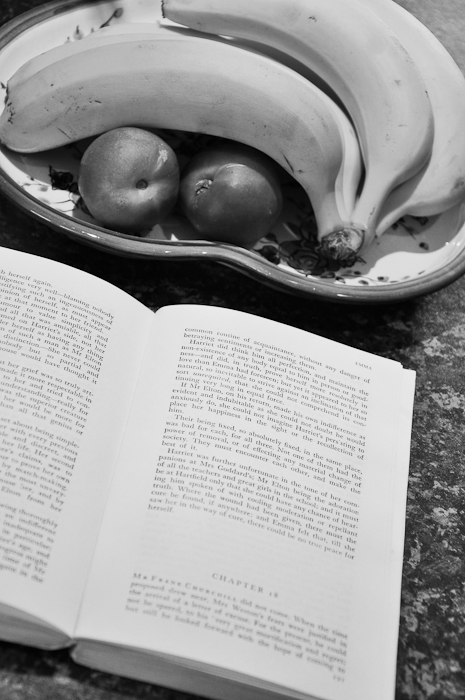
The bigger issue is the long term effect of relaxation of standards in our self-esteem. I thought of that over and over while reading Emma.
"Emma was sorry… to be always doing more than she wished, and less than she ought! Why she did not like Jane Fairfax might be a difficult question to answer; Mr. Knightley had once told her it was because she saw in her the really accomplished young woman, which she wanted to be thought herself, and though the accusation had been eagerly refuted at the time, there were moments of self-examination in which her conscience could not quite acquit her."
How many of us are like Emma today it seems: clever and just well-read enough to appreciate education, but not disciplined enough to have truly acquired academic excellence. We are articulate, versus substantial. We like to think about thinking much as we like to think about exercise, nutrition, theology, teaching, homemaking, or any number of other topics far better than actually digging into the doing of them, which is always conserably less romantic.
These are the things I have been chewing on lately, particularly as we prepare for another year of learning. (and travel and sports and arts…) It is always daunting initially, looking at the year ahead and all we hope to accomplish, all we really must fit in. Step by step and day by day we proceed and, by the grace of God, succeed more often than not. Having these reminders helps.
It's been an eclectic summer of Grace Livingston Hill, Beverly Cleary, and Jane Austen on one hand. Hanson, Raymond Moore, and a handful of social science titles on the other.
Brain is full. : )


































 Starry Sky Journal