A Prayer for October

We learned something new in our adult class on the Faith last night.  We always do. We discussed Pope LeoXIII's Encyclical Quamquam Pluries, On Devotion to St Joseph.  It was written in 1889, but reading through it is apparent how applicable it is today.  I will just pull a couple excerpts:

"…you know the times in which we live; they are scarcely less deplorable for the Christian religion than the worst days, which in time past were most full of misery to the Church. We see faith, the root of all the Christian virtues, lessening in many souls; we see charity growing cold; the young generation daily growing in depravity of morals and views; the Church of Jesus Christ attacked on every side by open force or by craft; a relentless war waged against the Sovereign Pontiff; and the very foundations of religion undermined with a boldness which waxes daily in intensity. These things are, indeed, so much a matter of notoriety that it is needless for Us to expatiate on the depths to which society has sunk in these days, or on the designs which now agitate the minds of men."

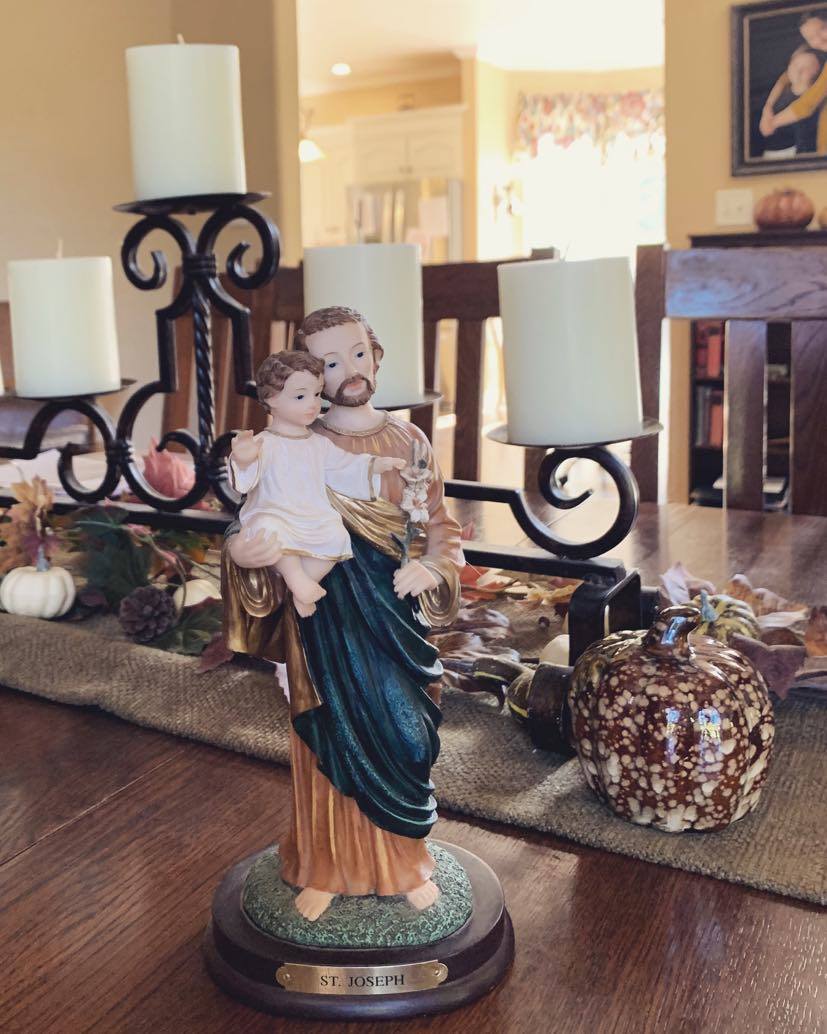
He goes on to give some guidance especially for October, already consecrated to the Virgin Mary under the title of Our Lady of the Rosary.  St Joseph lived with Jesus and Our Lady for many years.  Their care and support was entrusted to him alone.

"…during the whole course of his life he fulfilled those charges and those duties.

He set himself to protect with a mighty love and a daily solicitude his spouse and the Divine Infant;

regularly by his work he earned what was necessary for the one and the other for nourishment and clothing;

he guarded from death the Child threatened by a monarch's jealousy, and found for Him a refuge;

in the miseries of the journey and in the bitternesses of exile he was ever the companion, the assistance, and the upholder of the Virgin and of Jesus."


He does on to explain why,"men of every rank and country should fly to the trust and guard of the blessed Joseph." He is the personification of paternal vigilance, the perfect example of love between spouses, protector of the vulnerable, who passed his own life in humble labor, content with slight possessions.  Next to Jesus and Our Lady, he is a most efficacious intercessor in Heaven for all families. For that reason the Holy Father made this request:  

"We prescribe that during the whole month of October, at the recitation of the Rosary, for which We have already legislated, a prayer to St. Joseph be added."

It is a small thing, a simple pious practice we can join to the daily rosary this month. The prayer he composed is here:

Prayer to Saint Joseph

To thee, O blessed Joseph, we have recourse in our affliction, and having implored the help of thy thrice holy Spouse, we now, with hearts filled with confidence, earnestly beg thee also to take us under thy protection. By that charity wherewith thou wert united to the Immaculate Virgin Mother of God, and by that fatherly love with which thou didst cherish the Child Jesus, we beseech thee and we humbly pray that thou wilt look down with gracious eye upon that inheritance which Jesus Christ purchased by His blood, and wilt succor us in our need by thy power and strength.

Defend, O most watchful guardian of the Holy Family, the chosen off-spring of Jesus Christ. Keep from us, O most loving Father, all blight of error and corruption. Aid us from on high, most valiant defender, in this conflict with the powers of darkness. And even as of old thou didst rescue the Child Jesus from the peril of His life, so now defend God's Holy Church from the snares of the enemy and from all adversity. Shield us ever under thy patronage, that, following thine example and strengthened by thy help, we may live a holy life, die a happy death, and attain to everlasting bliss in Heaven. Amen.

Joseph

Joy Dwells

We study vintage home illustrations from the 40s, 50s and 60s -- listing  the architectural and lands… | Ranch house exterior, Ranch house remodel,  Ranch style homes

To the Little House

by Christoper Morley


Dear little house, dear shabby street,

Dear little books and bed and food to eat!

How feeble words are to express

The facets of your tenderness.


How white the sun comes through the pane!

In tinkling music drips of rain!

How burning bright the furnace glows!

What paths to shovel when it snows!


O dearly loved Long Island trains!

O well remembered joys and pains,

How near the housetops Beauty leans

Along that little street in Queens!


Let these poor rhymes abide for proof

Joy dwells beneath a humble roof;

Heaven is not built of country seats

But little queer suburban streets! 


This little poem in one of our readers rang so true.  Nearly half the homes I have lived in (and there have been 22 now) have now been demolished.  Most were quirky. Modest. Like the before's in the house flipping shows.  I have the fondest memories of them and the life lived in those odd little houses. No amount of decor makes for joy. The children are oblivious to the design anyway.  It's in the living and the outlook. They will remember how they felt there. 


one tiny little act

Aug  2020 maddie web-3577

"Walk worthy of the vocation in which you are called, with all humility and mildness, with patience, supporting on another in charity, careful to keep the unity of the Spirit in the bond of peace." Ephesians 4:1-3

Divine Intimacy tells us it is easy keep the bond of peace when we are truly humble, meek and patient.  Such a soul is said to "bear everything with love, carefully trying to adapt itself to the feelings and desires of others, rather than asserting its own." However it also points out that this is very difficult here below because self love continually "asserts its rights" creating "continual clashes, the avoidance of which calls for much self-renunciation and much delicacy towards others."

Very often, the author points out, "the cause of division among good people is excessive self assertion: the desire to do things ones own way." He states certainly that, "there can be nothing so absolute in our ideas that it cannot give way to the ideas of others."  If our ideas our good, others may also be good.  They may be better. Therefore he says, "it is much wiser, more humble and charitable to accept the views of others and to try to reconcile our views to theirs." 

He goes further to say, "We should be persuaded that all that disturbs, weakens, or worse still, destroys fraternal union, does not please God." He says this is so even when we are moved under the pretext of zeal.  So long as it does not interfere with our fulfillment of duty or the law of God.  Remember too, we are called to live out that law, not to loudly condemn all who do not.  They will have their hour of reckoning.  May God be merciful to us all in that regard. 

The closing prayer reads in part:

"O Word, Son of God, You look with more complacency on one work done in fraternal union and charity than on a thousand done in discord;

one tiny little act, like the closing of an eye, performed in union and charity, pleases You more than if I were to suffer martyrdom in disunion and without charity.

You are the source of all peace."


From the Liturgy:

Where charity and love are, You are there also, O Lord!

Your love, O Christ, has united us in one body with a sincere heart.

Grant then that we may love one another with a sincere heart.

Keep far from us all quarrels and contentions;

grant that our hearts may always be united in You and do You dwell always in our midst.

It was Mother

" It was Mother who spun the stories that made the things we studied really unforgettable.  If Dad saw motion study and teamwork in an anthill, Mother saw a highly complex civilization governed, perhaps, by a fat old queen bee who had a thousand slaves bring her breakfast in bed in the morning. If Dad stopped to explain the construction of a bridge, she would find the workman in his blue jeans eating his lunch high on top of the span. It was she would made us feel the breathless height and relative puniness of the humans who had built it. Or if Dad pointed out a tree that had been bent and gnarled, it was Mother who made us sense how the wind, beating against the tree in the endless passing of time, had made its own relentless mark."

from Cheaper by the Dozen

Sept 2020  m will omaha web

Renewal

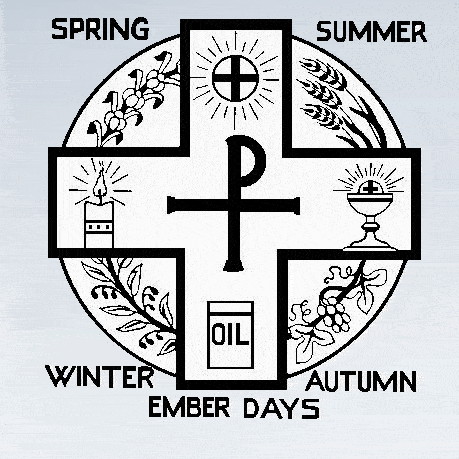
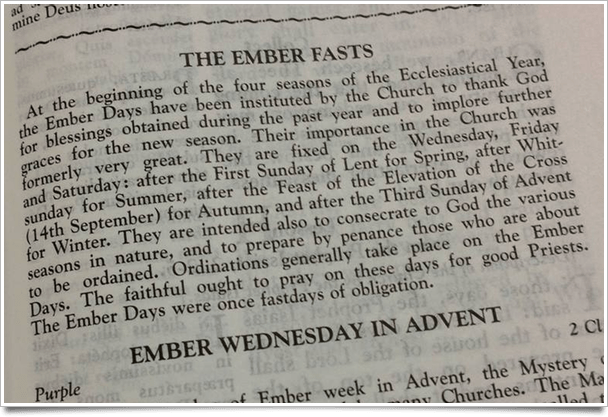
What are Ember Days and what is their place in the life of the Church?

"Four times a year, approximately three months apart, near the beginning of each season of the solar cycle (winter, spring, summer and autumn), the Church set aside three days (a total of twelve days in a year) to ask for blessings upon mankind, and to pray in gratitude for the blessings of nature, particularly those used by the Church in her Liturgy, such as olives, grapes, and wheat.

This is also a time set apart to thank God for the sacraments and pray for priests, particularly those who were being ordained. These days are marked with prayer, fasting and abstinence and stress spiritual renewal;

Ember Days could be regarded as quarterly spiritual check-ups."

Ember Days, Catholic Culture

Today we have the first of the three autumn Ember Days which follow the Exultation of the holy Cross, where we fast (one meal and two snacks) and observe partial abstinence (meat only once at our main meal). People tend to drift over time. It's human nature.  No matter how sincere we may be when we make resolutions, the following months often find at least some of these relaxed or perhaps abandoned altogether.   These days serve as a sort of reset at the beginning of each new quarter. We mark the change of season and set aside a few days of self-discipline to dedicate them to God and ask Him to bless them.  We can also use this time to rededicate ourselves, to see where we have had backsliding, and shore up our routines and devotions. 

An adult son and I were discussing ways you can arm your children.  One such way, which is repeatedly asserted in books like Mother Love, is to help them gain mastery over their appetites.  To accustom them to being content with simple food, to rise promptly, and endure minor discomforts with composure.  These are disciplines largely cast aside in our era.  We are reminded however, that those who are faithful in small things will be faithful in greater.  Ember Days offer one such tool to cultivate faithfulness. 

image: Kendra Tierney


Ember Days - Mater Dei Catholic Parish

Do likewise

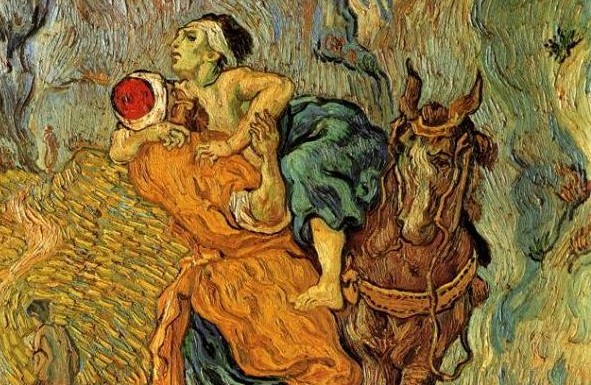
I meant to share here a wonderful reflection Father shared about The Good Samaritan. It expounded upon Origen’s commentary which I had not read. It falls in the category of stories you think you know but later realize you've simply skimmed the surface.

 Father gave some historical background to put the parable in context.  The traveler in the story is journeying from Jerusalem to Jericho.  Jerusalem is often a metaphor for heaven whereas Jericho represents the fallen world. As so often happens when we move away from things of God and towards the fallen world, the man is beset with trouble (sin) which nearly kills him.  The priest and Levite represent the old law which point out the wrong he committed but offered no compassion, no healing.  
The Samaritan goes above and beyond to “bind the wounds.”

Father encouraged us to consider multiple applications of the metaphors here. He reminded us that Samaritans were considered a lower class whose heritage had been diluted and adulterated by years in captivity.  And yet this Samaritan demonstrated far more compassion and empathy than those men who had the benefit of lifelong faith and teaching. 

The reality is we are often outdone in charity even today. Our first response is more likely to be judgement or irritation or nonchalance.  Instead of meeting our fellow travelers where they are, which might not be pretty, we pass by with little more than disgust.

Jesus simply says of the Samaritan:

“Go and do likewise.” 

Church Fathers commentary here 

ancient history background with excellent video here 


When we are so right we are wrong

Lily web

"In this world of corruption there is a real danger that the earnest Christian may overreact in his resistance to evil and become a victim of the religious occupational disease, cynicism.  The constant need to go counter to popular trends may easily develop in hime a sour habit of faultfinding and turn him into s sulky critic of other men's matters, without charity and without love. 

What makes this cynical spirit particularly dangerous is that the cynic is usually right.

His analyses are accurate, his judgement sound. He can prove he is right in his moral views; yet for that… he is wrong, frightfully, pathetically wrong. But because he is right, he never suspects how tragically wrong he is…."

A.W. Tozer


 I had not been able to articulate specifically what was bothering me about so many things written and reactions observed this year until I ran across this reflection, penned in the 1950's.  It echoes Nietzche's admonition:

"Beware that, when fighting monsters, you yourself do not become a monster…for when you gaze long into the abyss the abyss gazes also into you."

For all that is wrong with the world it is still in our best interest and in the best interest of all those around us that we strive to remain gentle and soft, that we cultivate joy and mercy, that we do not harden ourselves. Those are not things that the world does to us, much as we try to lay the blame there.  Those are things we do ourselves when our focus and motives are faulty. 

This month, like so many late summers before, I am filling myself up with inspirational reading to get fired up for this new school year.  It looks different for many of us, whether because we find ourselves with unexpected learning scenarios or without students in this season of life.  All those situations come with opportunities though. If we are teaching others then we certainly have no time to brood.  If we are in newly empty nest we have a likely long awaited gift of time and freedom to pursue our own projects. There is always something right in our laps or under our noses that would benefit from our attention. 

What about this coming autumn most excites you? What is inspiring you right now? Who or what could use your attention? 


Some places that fill me up:

Give Them Beauty

At Home with Nikki

Wildflowers and Marbles 

By Sun and Candlelight

Karen Andreola

CreativeLive

Classical Reading List

Clean Food Crush

BodyFit Weight workouts

Education, home, order, fitness, clean food, art.  I am not suggesting we make ourselves completely ignorant of the problems of the world. (I'd argue that is nigh on impossible, however.)  I am suggesting that this is ultimately how they are fixed: one person, one home, one act of gentle beauty at a time.  

The Informed Patriot

Photos Of Time Before The Invention Of That Grossly Antisocial Device: The Smartphone

"We must read our newspaper of course- newspapers on both sides; but he who founds upon his newspaper is an ignorant patriot and an illiberal citizen.

His opinions are no more than parrot-like repetitions of other men's sayings;

whereas he who dwells with dutiful interest upon the history of his own country, distressed over her ignominies, proud when she has shown herself great; who has pondered the history of another great empire – admiring the temperate justice with which its distinct colonies were administered, and scrutinizing the causes of its fall – he gradually acquires some insight as to the meaning of national life.  He is able to express an opinion which is not a mere echo, and gains convictions which will certainly be of use to his country, even if they are only known to the people about his own fireside." 

Charlotte Mason, Volume 4 Some Instructors of Conscience: History and Philosophy

Years ago, Laura Berquist urged readers to prioritize 'formation over information' though one could not argue that she did not value information as well. The trouble is that information by itself requires much interpretation and careful application. Hence the old adage: a little bit of knowledge is a dangerous thing. 

The idea that insight is acquired gradually is not a popular one in our day of instant everything. It used to be a commonly held belief that responsible citizenship involved a good deal of study through immersion in whole books on a variety of topics. Lately, while chatting with friends, one or the other of us will be challenged about how much we have read about a specific topic of current interest.  Often, either I or the other will have to respond with, "Very little."  The good news is we need not succumb to the pressure to hastily claim a position while having little foundational information to base that upon.  We can – ought – to step back and begin the laborious process of informing ourselves the same way our forefathers did.  As Miss Mason says, that involves reading from both sides of the aisle in any discipline.  It means avoiding the echo chamber like the plague.  

The informed patriot does not gloss over uncomfortable truths, nor does that history discount the indisputable forward steps.  This good citizen spends proportionately more time listening and observing than proclaiming or condemning. If the short, attention-grabbing newspaper articles of yesteryear were a concern for Miss Mason, I can imagine how distressed she would be to know how much of our contemporary worldview is drawn from brief statements of no more than 280 characters.  There is a great danger in confusing sloganeering with philosophy. 

The screens may be here to stay.  As we look ahead to both a new school year and an election year, I consider it one of my primary duties as an educator today, and a citizen, to keep them from usurping the position whole volumes ought to hold for us and for our children. 

Leisure

Jul 2020 tree buds web

What is this life if, full of care,
We have no time to stand and stare.

No time to stand beneath the boughs
And stare as long as sheep or cows.

No time to see, when woods we pass,
Where squirrels hide their nuts in grass.

No time to see, in broad daylight,
Streams full of stars, like skies at night.

No time to turn at Beauty's glance,
And watch her feet, how they can dance.

No time to wait till her mouth can
Enrich that smile her eyes began.

A poor life this if, full of care,
We have no time to stand and stare.

William Davies

In all our productivity, and amidst all our cares, may we make sure to carve out a bit of time to stand and stare.  


Mother Culture: summer reading – Incidents

"Mothers should cultivate their souls so that in turn they may cultivate the souls of their children."  

Karen Andreola penned those words long ago and later picked up the the term Mother Culture from a Parents' Review magazine.  For years she has promoted Charlotte Mason's insistence that,

"A mother reaps advantages by applying Miss Mason’s education-through-the-humanities. These cultural things aren’t frivolity but a person’s very bread of life."

I found myself malnourished in the humanities after several month's of the news monopolizing every screen I accessed. I know what to do when this happens. It is time for fresh air, for working with our hands, and for study – meaty, challenging study. I dimmed the screens and dove into books. 

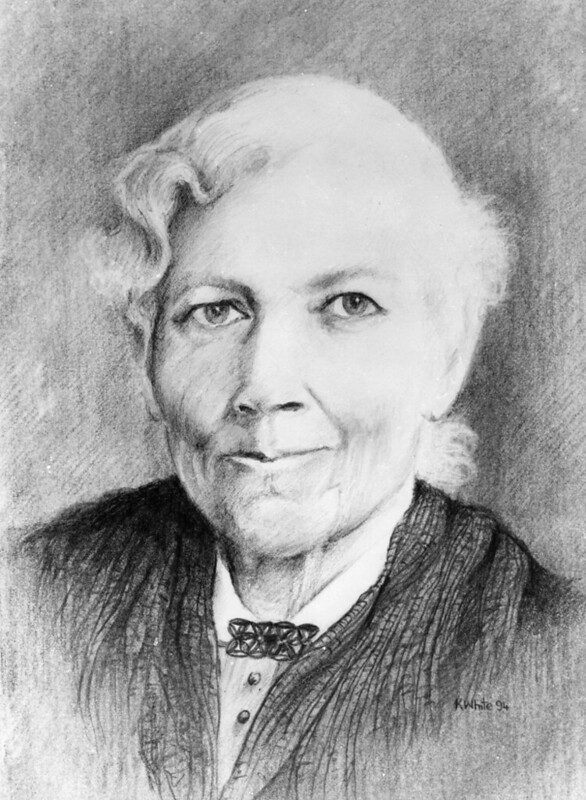
It was a day of celebration when our little local library branch opened for in person browsing.  Ordering books online was a lifesaver throughout the springtime quarantine, but you can't know what you're missing without walking the aisles.  When I was able to do that I found Harriet Jacobs' Incidents in the Life of a Slave Girl in the new books section.  I almost passed it up, thinking it was a new release fiction novel. That would not have been a non-starter mind you, but I was thrilled to discover it was a primary source memoir from 1862.  Over the next few days I read through the entire thing and was launched on a rabbit trail of research. 

6803434301_a8fddd33a5_c

“It has been painful to me, in many ways, to recall the dreary years I passed in bondage. I would gladly forget them if I could. Yet the retrospection is not altogether without solace; for with these gloomy recollections come tender memories of my good old grandmother, like light fleecy clouds floating over a dark and troubled sea.”

Harriet was born to a skilled carpenter who had been able to keep house with his wife and children. Hence for the first six years of her life she was unaware of her position as property of another. "Though we were all slaves, I was so fondly shielded that I never dreamed I was a piece of merchandise, trusted to them (her parents)for safe keeping…” When she was orphaned at six years of age she and her brother were moved to her mother's owner, Margaret Horniblow, where she was embraced and raised as a member of the family for another six years.  She was uncharacteristically taught to read and write during these years. 

6803433649_43a679fdf7_c

“When I was nearly twelve years old, my kind mistress sickened and died," writes Jacobs. "She had promised my dying mother that her children should never suffer for anything; and when I remembered that, and recalled her many proofs of attachment to me, I could not help having some hopes that she had left me free. My friends were almost certain it would be so. They thought she would be sure to do it, on account of my mother’s love and faithful service."  This was not to be however, as was usually the case with benevolent owners' wishes. Her heirs considered such affection to be absurd, indulgent, and financially impractical.  Harriet was moved to the home of a lecherous doctor and his family, where she – like innumerable young black women in her situation – endured all manner of abuse.  This is where the heart of the memoir begins.  It is an honest and unusually frank retelling and, though it has been established as accurate and factual, it apparently was too raw for 19th century sensibilities.  It did not go into a second printing and was only resurrected during the Civil Rights movement of the next century. 

6803433903_b5c3f47c50_c

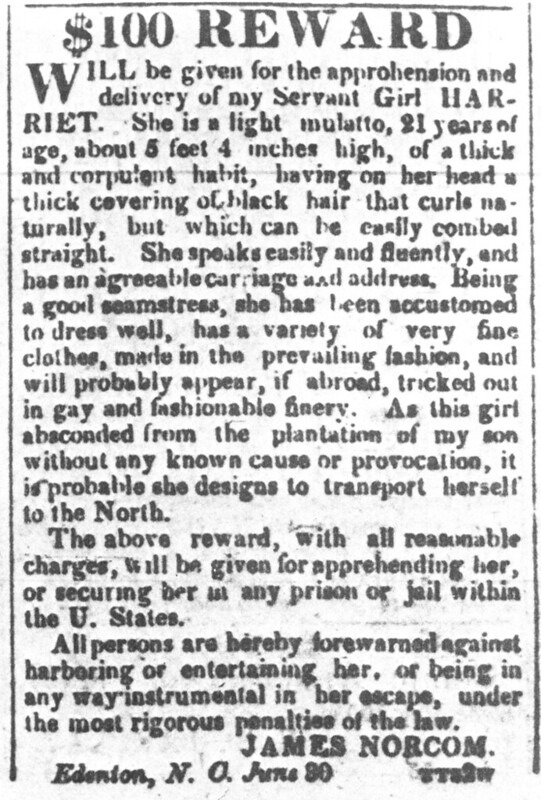
Harriet had an indomitable spirit and a clever mind. She foiled the doctor's attempt to break her and was driven to ensure the freedom of her children, conceived through a clandestine affair with a local landowner. Her free grandmother and uncle eventually conspired to hide her in a crawl space attic 9×7 feet and only 3-4 feet high for what ended up being seven years in nearly complete darkness save for a tiny hole she carved out to watch her children or catch the sound of their voices below.  Seven years. Body and spirit were nearly broken by the time she escaped.  Thanks to the Fugitive Slave Act, many more years of eluding the doctor would follow. He was close on her heels as she attempted to support herself and regain physical custody of her children.  (Louisa below)

Louisa_Matilda_Jacobs

Summaries of her story can be found here  

and here

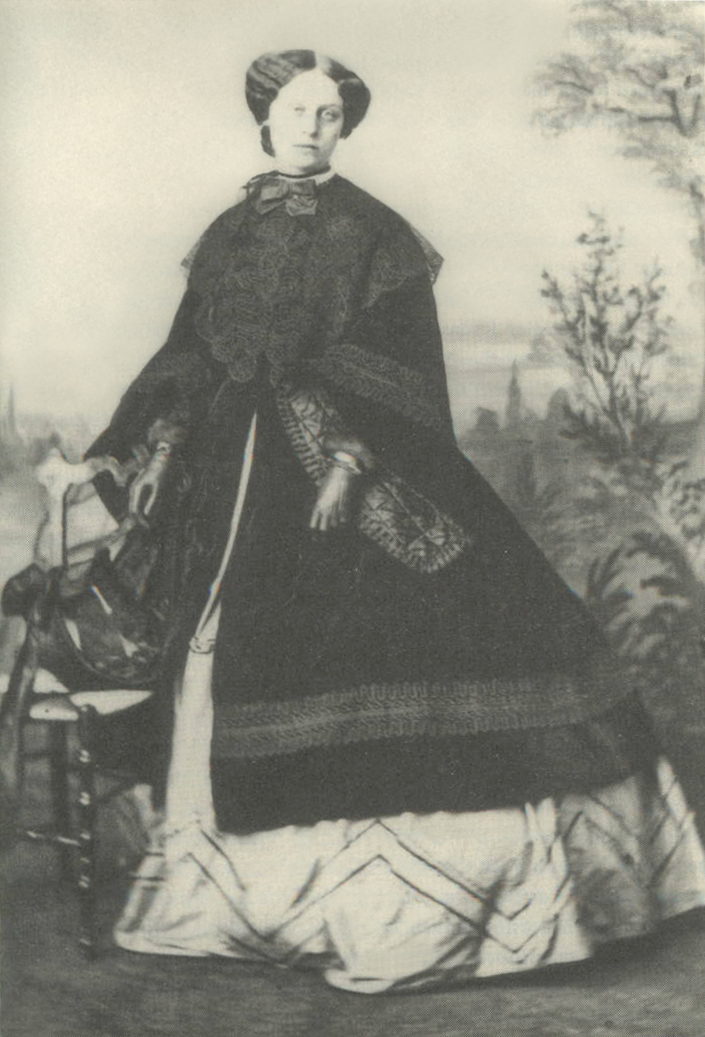
Harriet eventually found refuge in the home of abolitionist Nathaniel Parker Willis and his wife Cornelia Grinnell Willis.  Willis has been referred to as the Dickens of the West. The New York Times remembered Willis "as a poet, as [being as] popular with the mass of American readers as Byron was in England; his verses were the first found and the most read on the centre tables of polite society, and his prose sketches were deemed models of perfection" (New York Times, Jan. 22, 1867, 4)  After the doctor's death Cornelia Willis finally succeeded in purchasing Harriet's freedom.  Though grateful to have the long years of running behind her, Harriet expresses the outrage that such a thing was needed in a "free" nation,

“'The bill of sale!' Those words struck me like a blow. So I was sold at last! A human being sold in the free city of New York! The bill of sale is on record, and future generations will learn from it that women were articles of traffic in New York, late in the nineteenth century of the Christian religion. It may hereafter prove a useful document to antiquaries, who are seeking to measure the progress of civilization in the United States."

May we do just that – learn from it. 

Harriet worked tirelessly for the remainder of her life as an abolitionist and teacher of newly freed children and adults.  She and her brother ran a reading room for a time and she opened a school with her daughter. I will tell you what she knew and what I know to the true – reading is the great equalizer of persons. Education is a gift.  Never take it for granted and do not stop learning during the busy years, dear mothers.  There are stories you need to hear to make sense of your world. This is one of them.  


A related title here

Upcoming reading on similar themes:

Running a Thousand Miles to Freedom by William and Ellen Craft

Viktor Frankel Man's Search for Meaning

Walter Cizek's He Leadeth Me