
Every year my esteem for St John Bosco grows exponentially. I was not introduced to his teachings until the late 90s however there are many parallels in the Montessori method: respect, peace, observation of the child, alternating large muscle movement with periods of close concentration, and authentic faith practices that foster true comprehension.
This treatise remains my go-to best resource.
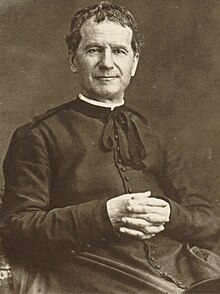
DON BOSCO – WRITINGS
THE PREVENTIVE SYSTEM IN THE EDUCATION OF THE YOUNG
CRITICAL EDITION: P. BRAIDO – TRANSLATION & NOTES: P. LAWS
TEXT
On a number of occasions I been have asked to express, verbally or in writing, a few thoughts concerning the so-called Preventive System which we are accustomed to use in our houses. Until now I have not been able to comply with this wish for lack of time, but since at the present moment we are preparing to print the regulations which now have been observed as it were by tradition, I have thought fit to give here an outline of it, which however will serve as a sketch for a small work which I am preparing, if God will give me life enough to be able to complete it. I do this solely to help in the difficult art of the education of the young. Therefore I will say: in what the Preventive System consists, and why it should be preferred; its practical application, and its advantages.
I: In what the Preventive System consists, and why it should be preferred.
Through the ages there have been two systems used in the education of the young: preventive and repressive. The repressive approach consists in making the law known to the students and then supervising them in order to detect transgressions, inflicting, wherever necessary, the merited punishment. Using this system the words and the appearance of the Superior must always be severe, and somewhat menacing, and he himself must avoid all friendly relationships with his dependants.
To give greater weight to his authority, the Director would need to be seen but rarely among his subjects, and generally speaking only when it was a question of punishing or threatening. This system is easy, less demanding and is especially useful in the army and among adult and sensible people who ought of themselves to know and remember what is according to the law and other regulations.
Quite otherwise, I would say its very opposite, is the preventive system. It consists in making known the rules and regulations of an Institute, and then supervising in such a way that the students are always under the vigilant eye of the Director and the assistants, who like loving fathers will converse with them, act as guides in every event, counsel them and lovingly correct them, which is as much as to say, will put the students into a situation where they cannot do wrong.
This system is all based on reason, religion and loving-kindness. Because of this it excludes every violent punishment, and tries to do without even mild punishments. It seems that this system is preferable for the following reasons:
1
Being forewarned, the pupil is not disheartened when he does something wrong, as happens
when such things are reported to the one in charge. Nor does he get angry from being corrected, or threatened with punishment, or even from actually being punished, because there has always been through the affair a friendly voice forewarning him, which reasons with him and generally manages to win his friendship, so that the pupil knows there must be a punishment, and almost wants it.
2
The basic reason (why young people get into trouble) is youthful fickleness which in a moment can forget the rules of discipline and the punishments they threaten. For this reason, a child often commits a fault and deserves punishment, to which he had not given a thought, which he did not remember at all in the act of committing the fault, and which he certainly would have avoided had a friendly voice warned him.
3
The Repressive system can stop a disorder, but only with difficulty can it improve offenders. One observes that young people do not forget the punishments they have suffered, and generally remain embittered, wanting to throw off the yolk, and even to take revenge. It seems at times they pay no heed, but anyone who follows them up in later life knows that the recollections of the young are dreadful, and that they forget the punishments inflicted by their parents, but with great difficultythose given by their teachers. Episodes are known of some who in their old age have exacted an ugly revenge for certain punishments justly inflicted during their school days. On the other hand, the Preventive system makes a friend of the student, who in the assistant sees a benefactor who gives him good advice, wants to make him good, to shield him from unpleasantness, from punishment, from dishonour.
4
The Preventive system offers the student previous warning, in a way that the educator can still speak to him in the language of the heart, whether during the time of his education, or later. The educator, having won the loving respect of his protege, will be able to greatly influence him, warn him, counsel him, and also correct him, even when he is employed, whether it be in the civil service, or in commerce. For these and many other reasons it seems that the preventive system should prevail over the repressive.
II: Application of the Preventive System
The practice of this system is all based on the words of St Paul, who says: Love is patient, love is kind … it bears all things … hopes all things, endures all things. ( 1 Cor. 13:4.7 passim) Love is kindly, and patient; it puts up with all things, but hopes all things and endures any disturbance. For this reason only a Christian can successfully apply the Preventive system. Reason and Religion are the means the educator should constantly make use of, teaching them, making use of them himself, if he wishes to be obeyed and to attain his goal.
1:
For this reason the Director should be dedicated to his pupils, nor should he ever assume tasks that would take him away from his duties; on the contrary, he should be among his pupils every time they are not taken up with other legitimate tasks, unless they are duly assisted by others.
2:
The teachers, the technical instructors, the assistants should all be of known moral rectitude.They should try to avoid like the plague every kind of (morbid) affection or exclusive friendshipwith the pupils, and they should realise that the wrongdoing of just one person can compromise an educational Institute. They should operate in a way that the students are never alone. As far aspossible the assistants should precede them to the place where they are required to assemble; theyshould remain with them until others come to assist them; they should never allow them to be idle.
3
Give them ample liberty to jump, run, make a din as much as they please. Gymnastics, music,declamation (of poems, etc), theatricals, hikes, are very effective methods for getting discipline;they favour good living and good health. One must only ensure that the plot, the characters and thedialogue are not unsuitable. That great friend of youth, St Phillip Neri used to say,
"Do whatever you wish; for me it is enough you do not sin".
4
Frequent Confession, frequent Communion, daily Mass are the pillars that ought to support an educational edifice, from which one would want to keep at bay threats and violence. Never require the youngsters to go to the Holy Sacraments, but just encourage them, and offer them everyopportunity to make good use of them. Then on the occasion of retreats, novenas, homilies, religious instructions, one should highlight the beauty, the greatness, the holiness of that Religion which proposes with such easy methods things as useful to civil society, to peace of heart, to thesalvation of one's soul, as are these holy sacraments. In this way the young people will becomeinvolved spontaneously in these religious practices, with pleasure and with fruit. (1)
___________________________________________
(1) Not long ago a minister of the Queen of England, visiting an Institute in Turin was taken to a large hall where about 500 boys were studying. He was not a little amazed at seeing so many children in perfect silence, with no supervision. His amazement grew even more when he came to know that perhaps in an entire year, one did not have to complain of a word being said out place, or so much as threaten a punishment, much less inflict one. "Tell me, how ever is it possible to obtain such silence and such discipline", he asked. And he added to his secretary, "Write down whatever he says". "Sir", replied the Director of the establishment, "the means we use is not available to you." "Why?" "Because they are secrets known only to Catholics". "What are they?" "Frequent Confession and Communion, and Daily Mass well heard." "You are absolutely right. We lack these powerful means of education." "If you do not make use of these religious means, you must turn to threats and the stick". "You are right! You are right! Religion or the rod, I want to recount this in London".
___________________________________________
5
Exercise the strictest vigilance to prevent there being allowed in the Institute friends, books or persons who carry on bad conversations. The appointment of a good doorkeeper constitutes a treasure for a house of education.
6
Every evening after the usual prayers, and before the students go to bed, the Director, or someone in his place should offer a few kind words in public, giving some good advice or counsel regarding things to be done or avoided, and let him try to glean these from events that have taken place that day in the Institute or outside. But his talk should never go on more than two or three minutes. This is the key to good behaviour, progress and educational success.
7
Avoid like the plague the opinion of any one who would want to postpone First Holy Communion to too old an age, when most times the devil has taken possession of the heart of a youngster with incalculable harm to his innocence. According to the discipline of the early Church it was customary to give to infants the consecrated Hosts left over from the Easter Communion. This helps us realise how much the Church loves to see children admitted to their First Communion in due time. Once a child can tell the difference between bread and bread, and shows himself to be sufficiently instructed, pay no attention to his age and let the Heavenly King come to reign in that happy soul.
8
Catechisms recommend frequent Communion. St Phillip Neri advised receiving once a week, or even more frequently. The Council of Trent states clearly that it greatly wishes every faithful Christian to also receive Communion each time he goes to Mass. But this communion should not only be spiritual but in fact sacramental, so that one may gain greater benefit from this august and divine sacrifice. (Council of Trent, session XXII, ch. VI)
III. Utility of the Preventive System
Someone might say that this system is difficult in practice. I reply that from the point of view of the students it turns out easier, more satisfying, more advantageous. In the case of the educator, it does include some difficult features, which however are diminished if the educator addresses the task with devotion. An educator is one devoted to the well-being of his students, and for this reason ought to be ready to face every inconvenience, every fatigue in order to achieve his goal, which is the civil, moral and intellectual education of his students.
Over and above the advantages set out above, I would also add:
1
The student will have the greatest respect for the educator and will go on recalling with pleasure the orientation he was given, always considering his teachers and the other Superiors as fathers and brothers. Wherever they go, these students are generally the consolation of their families, useful citizens and good Christians.
2
Whatever might be the character, the attitude, the moral state of a pupil at the time he is enrolled, his parents can be secure in the knowledge that their son will not deteriorate, and one may confidently assert that one will achieve some improvement. Indeed, certain youngsters who for a long time were the scourge of their parents, and were even refused entry into houses of correction, when cared-for according to these principles, changed their attitude, their character, they set themselves to live a decent life, and now fill honourable places in society, thus becoming the support of their families, and a credit to the area they live in.
3
Pupils having unfortunate habits who perchance should gain entry into an Institute will not be able to harm their fellows, nor will good boys be harmed by them, because there will be neither time, place, or opportunity, insofar as the assistant, whom we presume to be present, would rapidly put things right.
A Word on Punishments
What criteria should one observe when inflicting punishment? Where possible, one should not make use of punishments, but when necessity demands repression, one should bear in mind the following:
1
The educator at work amongst his pupils should make himself loved, if he wishes to be respected. In this case the omission of an act of goodwill is a punishment, but a punishment that acts as a challenge, encourages, and never disheartens.
2
With the young, what is used as a punishment becomes a punishment. One can observe that a less-than-loving look is for some worse than being struck. Praise when something is done well, blame when there is negligence, are already reward and punishment.
3
Except in very rare cases, corrections, punishments should never be given in public, but privately, apart from companions, and one should use the greatest prudence and patience to have the student understand his fault through reason and religion.
4
To strike one in any way, to make one kneel in a painful position, to pull any one's ears andsimilar punishments should be absolutely avoided, because they are forbidden by the law of the land, they greatly irritate the young, and they degrade the educator.
5
The Rector should make the rules well known, along with the rewards and punishments set down in the disciplinary policy, so that no pupil might be able to excuse himself by saying he did not know what was commanded or forbidden
If in our houses this system is put into practice I believe that we will be able to achieve excellent results without resorting either to corporal punishment, nor to other violent punishments. For these forty years during which I have dealt with the young, I do not remember ever having used any kind of punishment, and with the help of God I have always got not only what was necessary, but even had my wishes met, and that from those same young people for whom every hope of a good outcome seemed in vain.
Sac. John Bosco.


















 Starry Sky Journal