Storage or where to go with it all

Elizabeth Donna Marie Theresa and the 4Real Ladies  have been sharing hands-on learning ideas lately which got me thinking. Homeschools rich in manipulatives are soon challenged by what to do with them all, especially if there are tiny people to watch out for.  Traditional Montessori environments call for open, uncluttered displays of the manipulatives. This works well if you have a LOT less books and furniture than most of us have. It can be done however!  This site http://www.berteig.org/melanie/Haifa/Homeschool/montessori.html  shows a smallish home set up with traditional Montessori principles.  If you are just starting out (with kids, with *stuff*, with furniture) you might want a goal room like this to work towards.

Bags If displaying ALL your manipulatives at once is not practical, and it was not for us all the years we lived in military housing, you may elect to rotate smaller displays while storing the rest. Boxing and bagging are your best bets.  We love heavy duty zipper top Ziplock bags for storing just about anything. There are now two gallon sized bags perfect for oversized puzzles. I have typed out basic directions for use and taped them to the bag so if an older sibling wants to help they can easily see what to do.  The bags are see-through so there is still the element of self selection possible.

Boxes Bags can be stored several ways. You can put a small square of clear tape on the top corner and hole punch. Then several good sized bags can be strung on a large ring. Small bags can fit onto key rings. You can also hang the bags from multi-rack slacks hangers and store them easily in a closet.

Don’t forget other kinds of bags. Hanging shoe bags have unlimited uses! This site http://www.geocities.com/helenasplayhouse/PicturesNewChildCare.html has pics of of a home daycare provider’s setup.  She has labeled the pockets and hung them strategically throughout the house.  Just think!  You could store art supplies, flash cards, child sized table settings, fabric match games, color box cards, craft stick games, Cuisenaire rods, magnifying glass….  While your mind is full of closet organizer-turned-homeschool-organizer options consider hanging sweater bags as well. You can stack puzzles and games in those very nicely.

Jar Natural Structure recommends these screw top plastic containers for small items.  By the time their hands are large enough to open the tops they are generally responsible enough not to eat (or lose) the contents.

There is no end to box options. We like the clear cheap Ziplock containers.  Sterilite boxes are sturdier. Both stack well.

You don’t need to purchase new containers by any means. Look at what you are throwing out. Plastic baby wipe boxes are favorites of mine.  They stack also and have attached lids.  Empty oatmeal containers are good for storing large materials like braiding and lacing boards.  Neither the wipes nor the oatmeal boxes  are see through however so labeling is more important. 

Wipe_boxCdWhat else?  CD cases are very nice for holding the Montessori cards which are readily available from the Montessori Materials groups. They are the perfect size and you can store them vertically in a CD rack.

The playschool6 yahoo group has photo files of members’ environments.  These are great to give you ideas for how to house materials. Surfing for home daycare center images is also helpful.  These people generally have lots of stuff to store with the added pressure of home inspections.  As a result they have become savvy about storing their materials.  Whatever you decide to do commit to not bringing anything into the house without an appropriate storage  container.  You will save yourself lots of grief and lost pieces later.

Less is More – History

Dear friend Jen and I have been hashing out her boys’ high school (homeschool) history options.  The available syllabi have been universally expensive or cumbersome.  While reviewing some of the options I stopped and googled "world history outline" thinking it best to give palatable hooks to hang knowledge upon rather than inundate with details. Look what I found! Student’s Friend  It is very similar to the geography core book recommended in an earlier post

This course focuses on core knowledge the student can be expected to retain.  We assume that the student will read widely from primary and secondary sources and historical fiction to round out the course, but this would provide a free, thorough core. Since the information is reduced to core facts there is less editorializing than is typically found in such a course. Big plus. 

Included are blank outline maps, a basic list of questions, quizzes, and a short course in teaching philosophy for mom. This last part is a short summary of the ideas found in many homeschool manuals and websites. Good overview explaining the value of narration, timelines, and other home education standby’s with the added perk of translating them into edu-ese for you should you ever need to explain them that way.

To flesh out such a course consider these sites:

Timeline Helps from Homeschool in the Woods  gives lots of practical help and examples for creating timelines and notebooks. Historical Movies in Chronological Order  has a list and short descriptions of movies to enhance your studies. Mr. Donn’s has a collection of unit studies for each era, should you desire more hands on activities for some time periods. Chronological Art lessons is just what it sounds like.  One, not 5,000<g>, art projects for each major era. A History Reading List like this one is readily available in homeschool catalogs that specialize in teaching with real books. Keep it handy for library trips. The linked list has the advantage of including several free ebooks of original source material.  Kidipede History for Kids is a site suggested by Theresa which I had forgotten about.  It is perfect for incorporating younger students in your studies. This site Picture History is a great aid for narrations once you get to modern times. Otherwise we do google image searches to illustrate timeline and narration pages like this Download Esther.doc narration from our newly 12 yr old daughter’s Old Testament notebook.

Just remember it is NOT by any means necessary to all of these things, every week.  If you try your head may spin.  If you do incorporate art or geography or literature into the history course be sure to document that work for credits in those areas on your transcript. If you already have a history course you are satisfied with you might want to download this pdf file to use as a quick review of the essentials.

Happy history rabbit trails to all! (Speaking of which remember the 4Real board has a wonderful history forum )

Scrapbooks and Schoolbooks (and random thoughts about productivity)

M_i_am_from_2 The Where I am from poems had scrapbook potential all over them. It’s been way way too long since I sat and scrapped.  Far too long.  Scrapbooking used to be my defining hobby.  The *what I do* after being mom and farmer. Something about the combination of mom, farmer, and digital photography (vs. prints in my hand every week) pushed scrapping to the back burner since Brendan was born. That was a real shame. I missed it. So this week when my daughters wrote their own ‘I am From’ poems we sorted through the stash of papers and started to put pages together and it felt SO good!

I realized my scrapbooking has suffered from the same second-guessing my homeschooling has endured. In my guilt over productivity I look at our elaborate hand-made pages and think how impractical they really are. They take so much time and thought and coordination. What about Creative Memories old motto – better to have finished albums than creativity? Well I bought into that idea in both areas of my life at different times.  It IS tempting to question yourself when you see volumes of others’ finished pages. Still, the prospect of churning out mass produced pages like so many cookie cutters left me cold.  Cold enough that I just couldn’t do it at all if that was the way it was to be done.

Alannah_i_am_from_page Sitting at the table this week carefully matching up patterns and fonts, ribbons and tags reminded me how deeply satisfying the process itself is.  This isn’t about numbers. She who dies with the most pages does not win. : )  Rather, it is about putting yourself on the page, telling a story, and then illustrating it with lovely images.  I think, in the end, education is that for us also.  It is not about producing volumes of student work, but about touching their hearts. It is about inspiring them and about asking them to put care and forethought and passion into their work. It is not about checking off squares or being “done”. 

I guess my scrapbooks will never be “done” and with any luck at all neither will our educations. What I hope for instead is that they will nurture that drive to reflect, to create, and to express and not allow it to be crushed by quotas.  Education too is about the process.

Here is the text of Moira’s poem:

I am from…

The large yellow house with the old gray barn

Sweet baby goats, annoying chickens, and kittens fed with an eyedropper

A black Shetland pony that only I can ride

Planting gardens, doing math, and writing narrations

Keeping notebooks, drawing faces, and playing dolls

Cute babies who try to talk and play with toys too big for them

…whom I push around in the stroller or the wheelbarrow

The Buddy System

A purple room that my sister and I share

Big brothers who like music and basketball

A mom who milks goats and helps us with craft projects,

A dad who gets the guitar and sings songs even though he doesn’t know how to play

…who drives us around in the tractor,

Piano lessons on Wednesdays

A church full of friends and ladies who wear veils

I come from fun!

And Alannah’s:

I am from…

            Small yards in crowded base neighborhoods with kids everywhere


Long drives to new houses


            Green Virginia fields and yellow buffalo grass prairies

            Sadness at the airport, worry about Dad’s safety, relief at retirement

            Tractor rides and silly songs with Dad

            Waking up early, goats with full udders, hatching chicks, and crowing roosters

Wheechairs rolling down the halls, basketballs on hardwood floors, and the piano playing all day

Cutting out paper dolls, crocheting on the couch, and riding double

Little brothers, sword fights, and stick armies

Always a baby in the house, never in cribs

Watching the yellow school bus drive by while I sprout seeds, multiply fractions and read in the kitchen

Learning at my own pace

Working with our hands, read alouds, and family movie nights

Rock concert masses and soft Gregorian chant

The Rosary

Geography Copybooks

Geo_booksTo workbook or not to workbook?  That is the question many homeschoolers ask themselves every summer when purchasing curriculum. Truth is, workbooks are faster – faster for the kids and faster for the teacher. And they are cheap. Unless you are multiplying the cost of said workbook by four or more students and twice as many subjects. We had to seriously consider the wisdom of investing in consumable curriculum when we have so many students in our one-room school.  Not only did it seem like a poor use of money that could be spent on music lessons and riding gear, but we also wondered how much of all that quickly gained information was staying in their heads.  After all, how memorable were the workbooks from your childhood? 

All that consideration landed us with no geography workbooks this year. That was fine but it didn’t leave me with any more free time or brain cells to devise a ‘bells and whistles’ geography program either.  Nor do I have a great track record with non-consumable programs that have phone book sized manuals. Enter Charlotte Mason, Maria Montessori, and notebooking. These have been the mainstay of our homeschool program for many years and I thought I would share how we have been handling geography.

Some things go without saying.  For instance, whenever we read a book, watch a compelling movie, Dad goes on a trip, etc. we check the map and compare here to there. They draw maps of the places they study in history.  We occasionally do full country unit studies, complete with costumed dinners and related art projects. Occasionally. <g>  Some of those end up being lapbooked. (see photo albums)

For the more bits and pieces, everyday type of work we are adding pages to their notebooks of landforms and geographical vocabulary from the resources pictured. Maria Montessori is famous for her emphasis on nomenclature, a large word which essentially means naming a thing completely. Geographical nomenclature in Montessori schools begins with landforms. The children use cards such as the ones you can download from http://montessorimaterials.org/geo.htm#lan  They also make models of the landforms like these: http://www.montessoritraining.net/preschool_kindergarten/courses/culture_science/sample_lessons.htm

Geo_pageOne of my favorite books to introduce the landforms is Geography From A to Z. (I will upload it to the sidebar so you can ck it out) Each page has full color illustrations that are easily reproduced by children armed with markers or colored pencils. They read the entry and then fill out a portfolio page I set up in Word. Download portfolio_text_box_9.doc   I am uploading it here if it saves anyone time. They write the name of the form on the top, draw their version of the book entry in the large center box, and then a short definition in the lower box.  Done!

We use the Montessori cards to drill the vocabulary for retention. You can modify the cards by using sandpaper for the landform itself.  The landforms models can be made a few ways.  One easy option is to buy the new disposable Ziplock plastic storage containers. They are sold near the baggies. A low wide size is best and you will want all the forms to be made from the same type of container. They can use modeling clay (not Playdough) to press a form into the bottom of the container and then can fill it with blue colored water. You can outline the form in permanent marker on the bottom of the container if you like. To make a permanent form you can use the self drying clay or plaster or the like. We haven’t gotten around to that honestly.

087156430001For cultural studies we usually get a library book every month on a different country. Something simple like the Postcards From… series or whatever happens to be at the bookmobile. A favorite book of mine is Material World. Sixteen photojournalists travelled the world and chose one family to represent each nation. The families are pictured with all their earthly possessions in front of their homes. This makes a striking impression, particularly when you contrast a third world family with their pots, blankets, and baskets with a Western family who must be photographed from a distance so that all their belongings can fit into the screen of the camera.

For older children who have exhausted these resources I like Scholastic’s All the Geography Homework You Will Ever Need.  I remember reading years ago that instead of investing in repetitious curricula for each grade level it was wiser to buy a composite type reference book and use it year after year.  This would be that type of book. You can make notebook pages from the entries in here such as the three types of maps (political, physical, cultural) or cover things like biomes, migration patterns, or the atmosphere. It is an AWESOME resource for lapbooks also. Library books will flesh out the topics.

Better scoot here because my family will be home from their movie shortly!   

Check this out

Corba While we have been holed up here at the house I have had my nose stuck into the Anna Corba books I picked up this month. Ooooooh!  These are so pretty!  Anna Corba is a collage artist who works with vintage paper. There are enough buzz words in that sentence to make me check out anything with her name on it.  The two finds I am immersed in at the moment are Create with the Designers: Vintage Paper Crafts with Anna Corba  and Making Memory Boxes : 35 Beautiful Projects.  I am going to link up both on the sidebars. The latter is probably my favorite. I love the idea that you can make one spectacular storage piece and then throw lots of unaltered bits and pieces into it, like the modified vintage lunch box filled with keepsake cards and letters or the decoupaged recipe box. Inspiration by the page. : ) 

Speaking of inspiration, if you appreciate awesome photography check out Tara Whitney’s work. Tara Whitney   I hadn’t visited for a while and when I checked back she had loaded some incredible portfolios. I am itching to get my camera out and try some new angles now.

Favorite Preschool Supplier – Home Depot : )

100_1346You probably got a hint of this already but let me lay it out for you – I am cheap.  I have an awfully hard time buying anything that could concievably be made.  And even some things that can’t lol!  <g>  This has led to some botched construction projects but also some great successes.  My favorite preschool and early elementary books are by Labritta Gilbert and Mary Baratta-Lorton, probably because these women had a gift for using common materials in uncommon ways.  After seeing their ideas you stop looking at hardware and you start seeing fine motor perfectors.  You stop seeing lumber and start seeing manipulatives.

100_1345_5100_1347These are a few of the materials we have made from these books. (see sidebar) The first is a lacing bar.  Next is the pegboard.  They use golf tees to make patterns. Before we had the board we poked a series of hole around the outside of a bowl’s plastic lid.  That worked well too.  The 100_1348bolt board is new for us.  Before Allen made it we had a bowl of nuts and bolts in various sizes and they worked with them that way, which worked fine also. This is a bit easier for the smaller boys though.  The braiding board is an 18" 1×2 board with a hole drilled at the top and cording pulled through.  This is more of an elementary task.

Baby games

March_06_026_2Just a couple more games for little people.  Nienhuis Catalog and other Montessori providers offer several wooden box toys to the tune of $30 or more.  The concept seemed easy enough to replicate with what we had in hand.  The first toy we made for Brendan was from an oatmeal box.  I cut a circle in the lid big enough for ping pong balls to fit through.  Then I made a keyhole at the base for him to reach into to retrieve the balls.  BIG hit. : )   

Straw_gameThe next was a raisin box with a hole punched at the top just wide enough for plastic straws to slide into.  This silly game was also a favorite at the co-op. 

What the Preschoolers Have Been Up To

I have been teaching a preschool class in our homeschool co-op since January.  It has been an interesting experience for all of us.  Our kids loved the interaction.  The facility was nice and large enough for all of us super-sized families to gather comfortably.  This alone meant we saw more of our friends than we usually do.

100_1222_1This was my first attempt to translate the Montessori activities I have been using at home for the past nearly two decades (ouch – that makes me sound WAY too old lol!) into the classroom.  The birdseye view of Montessori in action in a group setting was priceless.  It really does work! I have been very encouraged to see children with such a range of ages and personalities work together peacefully and orderly. Mostly <g> 

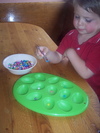
100_1223_2Here are some pics of yesterday’s work. We found the patterned plastic eggs at the dollar store and the egg tray at Walmart in the Easter section.  They paired the eggs with the same patterns and placed them on the tray. This work was meant for the very littlest ones but surprisingly the older kids always take a turn with it. I also used the egg tray with pony beads for sorting by color.  Tweezers kick it up a notch.  Some of the children were not able to manipulate with the tweezers but those who did were very pleased with themselves.
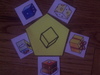
The other game is based on an idea I saw in the Toys For Life catalog. We made pentagons and placed a geometric solid image on each.  Then I had some pictures from an old math workbook of items that fell into those shape categories – cylinders, cubes, sph100_1221_2eres etc. I copied those and laminated them.  They sorted the images by shape around the proper pentagon. Easy to make!  Tricky to play, said my four year old on his first try. If you own the wooden geometric solids ala Montessori you could place one of them on each card instead as a variation.

100_1219_1Will we do it again?  I am not sure.  While we loved the interaction we certainly picked up our share of *bugs* this year.  We have never done a church nursery type of thing before and my presence couldn’t prevent the baby from the germs inherent in the setting.  He spent a wknd in the hospital in Jan with RSV and we had a bout with what I suspect may have been rotavirus later in the session. In my heart I believe nursing babies and their mamas ought to be mostly at home – resting, playing, working together and bonding.

Keep checking back and I will keep posting the activities when I get snippets of time here.