wow

Dear children,

Consider this my resignation.   Henceforth you will be going to school in this breathtakingly gorgeous environment.   Please do not bring home pictures to show your father.  I may never be able live it down!  

Signed, 
Your loving, yet far less organized mother
Jennifer if you think a half dozen extra students might be too much, would it be ok if I just came alone to sit in your schoolroom for a while?   

Sigh.  

It is beyond words.  Brava!  

Plato, Aristotle, Montessori, and Waldorf

Seems an unlikely bunch doesn't it?  Yet an article in The Classical Teacher illustrated quite well the basic difference between the two very popular educational methods.  Homeschoolers often begin with materials or programs and work backwards into a philosophy.  It is helpful, in fact often critical, to determine the ideology behind one's materials.  The ideology does not dictate the materials' use in your home but it can help to sort through the authors and companies competing for your attention and your wallet.  It can help you avoid unnecessary and undesirable rabbit trailing.  

In his article, Martin Cothran compares and contrasts the most basic positions of two ancient philosophers.  Plato, he says, emphasized the spiritual realm and felt that physical objects were reflections of that spirit world.  Aristotle believed the essence of things resided IN the things themselves.  They were real physical forms inhabited by spirit. Why does this matter to a busy homeschool mom?  Lets put it in practical terms.  We choose to teach either from the concrete to the abstract or vice versa.  It is important to know how you feel about this and choose materials and methods accordingly. 

Montessori moves from the concrete to the abstract, hence the emphasis on physical manipulation early on.  She believed that small children relate best to what they can see, smell, hear and touch.  They begin with the physical world and move into the spiritual or abstract.  From things to ideas.  

Waldorf does things the other way around.  The belief in reincarnation is largely responsible for this inverse order.  Steiner believed that people were essentially spirits who occasionally reincarnated into the physical world.  Children, believed to be newly arrived from this spiritual realm, were more familiar with ideas and images and had to be slowly  acclimated to physical life.  Hence the reluctance to introduce text and data at an early age. 

Both methods intend to move from the known to the unknown. They simply have a different position on what constitutes "known" for a small child.   Consequently the methods, while they enjoy some overlap, are essentially the inverse of one another.  While materials for both methods are now widely available and often exceptionally attractive they do offer completely contrasting approaches.  This article may help you make choices among them and determine very practical things such as whether you will proceed from the whole to the parts or the parts to the whole.  In the end, most curricula can be divided into one of those two camps.  

parting thoughts from the High Desert

Susan will be closing her blog down soon.  If you have not printed pearls of wisdom you wish to remember from there now is the time to do so.  In one of her last posts Susan left us with some final comments about home education, education in general really.  She reiterates my own feelings about gentle yet responsible teaching.  A few highlights:


<<Read. Think. Do. But don't overdo.>>

DSC_0175
Enough said there. I love her emphasis on doing but not OVERdoing which is a great temptation in our day of co-op classes, unit studies, and ideology overload. Which things do we do?  She answers, 

"We did real things. We tried to avoid things that kept us from the real things, the good things, a true education."
 This bears consideration.  To flesh that out further I would warn against that which is contrived, make-work, or cumbersome in any way. Avoiding doing things out of guilt, as in, "Everyone else is…."  One homeschool mom confided the other day that she felt almost guilty because her days have been running so smoothly.  Instead of reveling in that harmony, she wonders if that means she ought to add more.  That is a feeling many of us have had.  We shouldn't.  We should be zealously guarding the margin in our lives. That is healthy.  That is necessary.  It is dangerous to be without one. 

DSC_0949

Susan balances the creative gentle learning with this:

"..we all took it seriously.  If one wants to create a learning lifestyle atmosphere, it takes a lot of work to do it.  If we are home educating, then education is not to be shrugged off."

It is tempting to lose ourselves in lovely visions of children teaching themselves calculus, painting watercolors, and keeping marvelously tidy rooms while we knit and catch up on all the classics we missed.  Reality is a bit messier.  Habit formation and the mastery of skills take a lot of deliberate effort. 

It is easy to get caught up in all the many things vying for our time and attention. Yes, we paint.  We make music.  We do many lovely things together. But we are deliberate as well. We are purposeful in our choices.  And we "work within the reality of our situations."  

DSC_0901

What Susan, as Art Robinson and Andrew Campbell and others (see sidebar right) are sure to choose daily are reading, writing, and math.  They are the big fish which should not be shrugged off. Beyond that most healthy active families will have countless opportunities to explore their worlds.  
<<Besides prayer, the three most powerful tools in a homeschooling parent's toolkit are:

1. Example
2. Example
3. Example

In other words, at the most basic level of all, do as Gandhi said, and "be the change you want to see in the world.">>


This is the advice I so often wish to tattoo on my forehead.  It is that simple in the end. Be what you wish them to be because they will be molded and formed in large part by the example you provide.  Elaborately coordinated curriculum cannot compensate for poor example. Better to have a little with peace than plenty with strife.  Do a few things well.  Be loving.  Be responsible. Never tell yourself that is not enough. It is everything. 


DSC_0705

notebooks from textbooks

We found ourselves with a bit of a curricular dilemma in recent years.  The rationale behind Waldorf main lesson books was compelling to me.   What was less appealing was constructing an entire curriculum from scratch and then figuring out which/how many lessons to notebook..  Actually it wasn't so much that it didn't appeal to me.  In truth it appealed to me so much I knew how easily I get drawn into lesson plan creation and how little time that leaves me for actual teaching and follow up (and chores and hobbies and so on).  There are choices to be made when dividing our time and we had to be realistic when we made them.  At this stage in our family life, this was how best to allocate that time to assure there was plenty leftover for games and stories and crafting and praying and the countless delightful things that I wanted to fill their childhood. 

Another problem was finding a suitable source for the initial information.  There is no shortage of picture books and fiction books for various topics.  My storage space and budget however, are definitely finite. To replicate the information found in one classic text required dozens of single topic titles. This was not easily reconciled with the space left on the shelves and tables. Additionally I had a deep desire to impart Christian content to my kids.  Most books listed for topical studies were secular.  

I have also considered the arguments Waldorf authors have shared for the merits of creating images from words.  Purist Waldorf teachers (though admittedly I am not that!) tend to eschew glossy, photo rich books for those with rich text coupled with lots of discussion. The idea behind the main lesson books is not to study someone else's images, lovely as they may be, but to really assimilate the information and to share the pictures it planted in your own mind. 

Ironically some of my old Catholic school books seemed to fit the bill perfectly.  Unlike contemporary texts written by committees, these – as is the case with the Ambleside and Old Fashioned Education titles – were written by individual authors.  They were often written in story form and addressed the student directly.  They can be shy on illustration but are full of solid Christian content.  For these reasons, they won out in the end. 

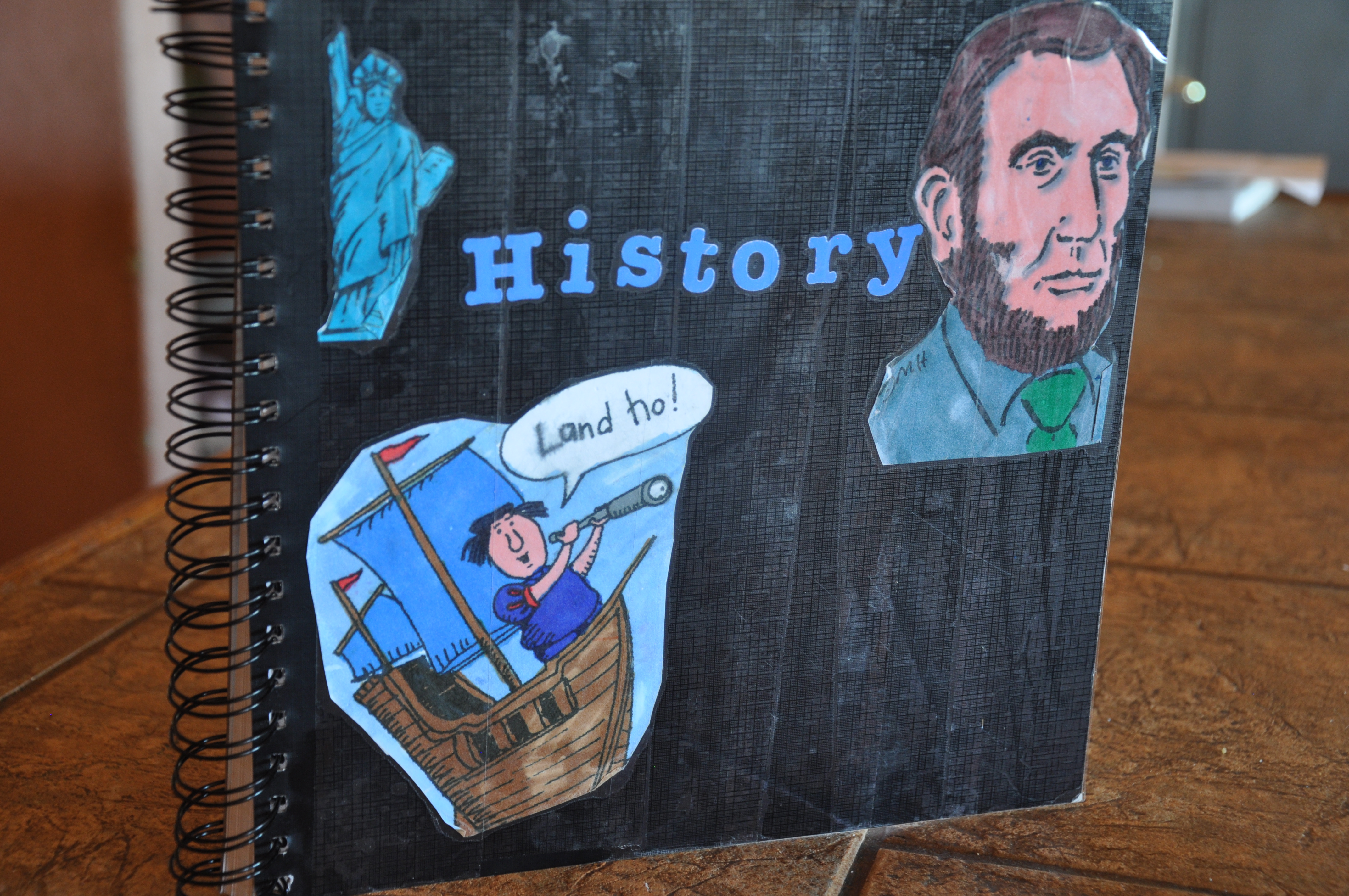
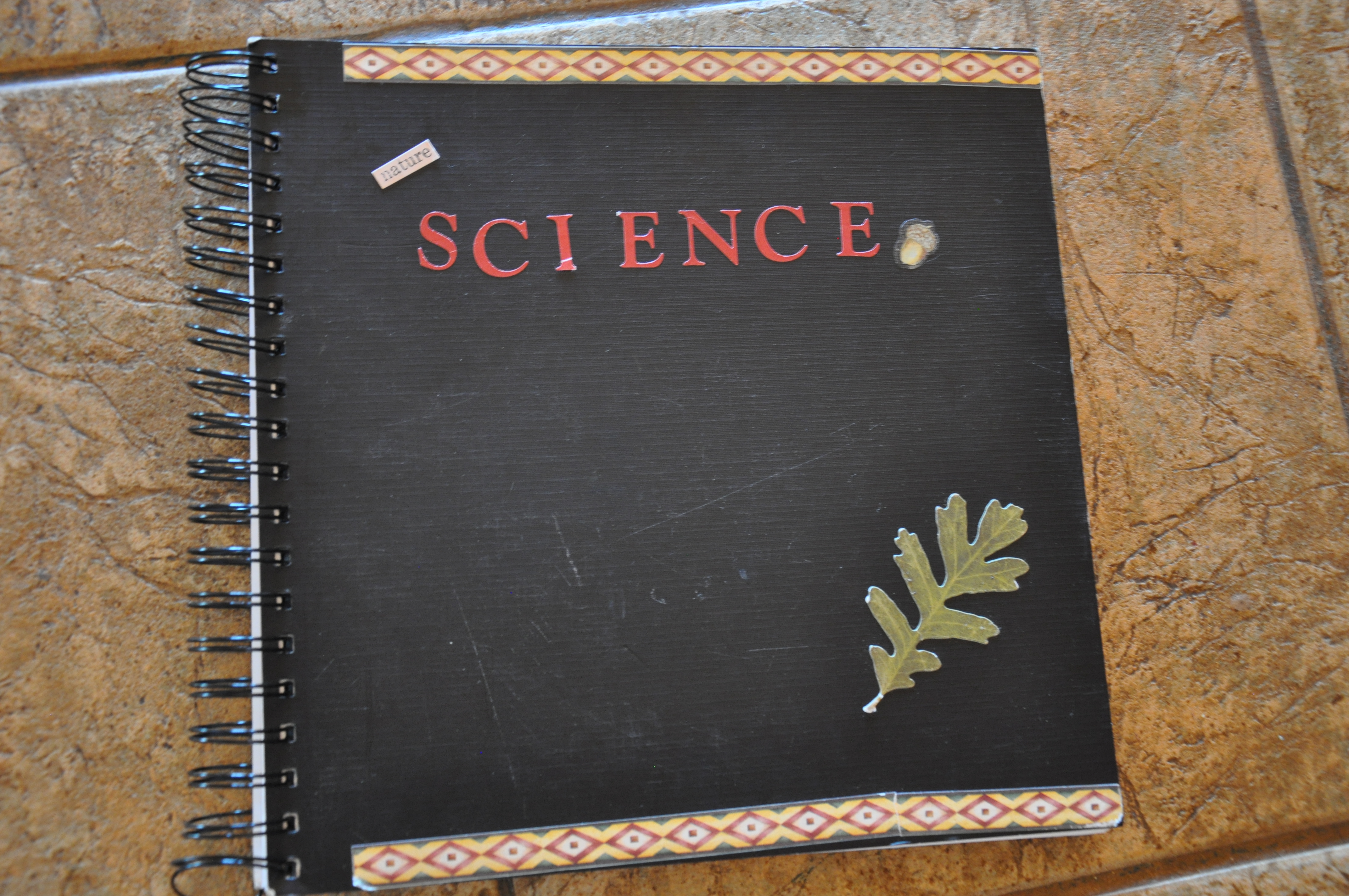
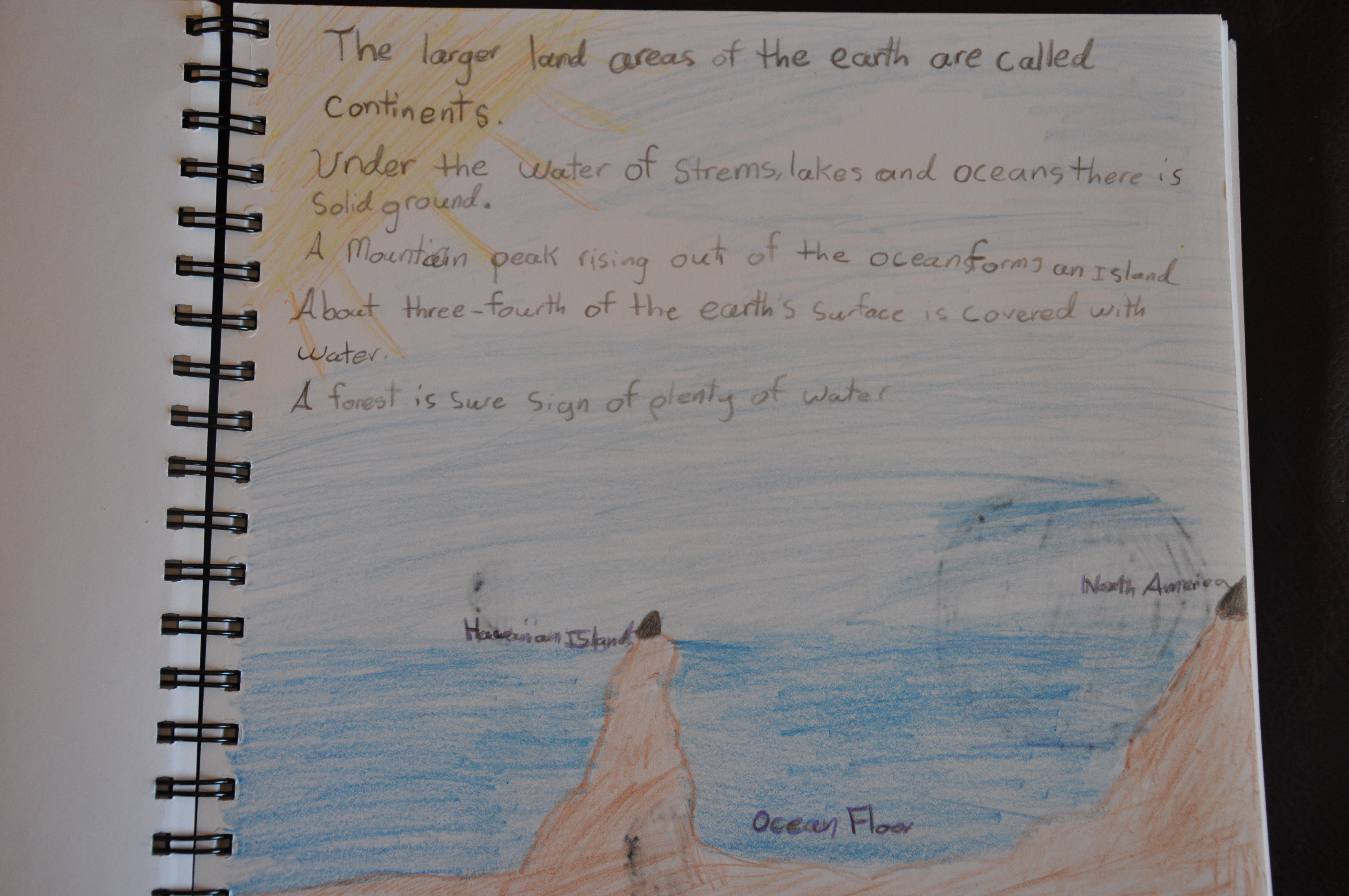
Here is what we did for our middle school level daughter.  We took a 10 by 10 scrapbook album. ($6 at WM)   She decorated the front for history.  We flipped the book over and she made a science cover on the backside. She then began at the front making history pages and from the back to the center she made science pages.  (an idea we got from Oak Meadow School)  This solved the problem of loose pages and also of having to fill a large notebook.  

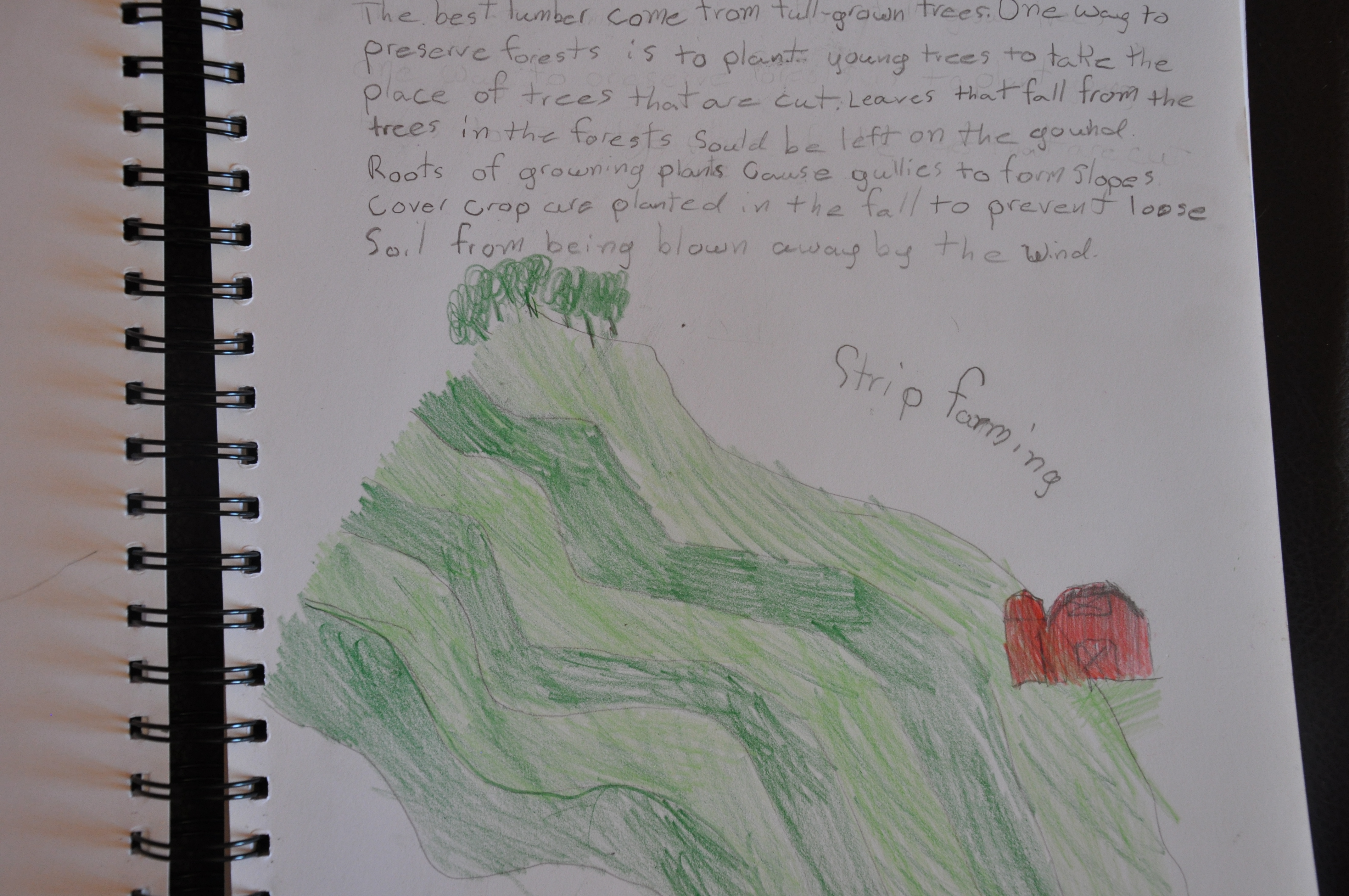
She read the text selection, then answered the questions on a notebook page. She drew pictures to correspond to the text.  Yes, sometimes she uses a text illustration or chart for a starting point.  Other times she creates from imagination or from field books (in the case of science).  Sometimes she will use the essay questions as a writing prompt.  Other times she will just answer the comprehension questions right in the notebooks.   

We are both happy with the results. She has learned a great deal with very little prep on my part.  It has been exceptionally user friendly that regard. I have been able to focus on discussion and helping to make connections when we are at museums or reading chapter books.  She has a beautiful notebook as a great keepsake.  I will be sharing what we have done for other students in the coming days. 

front cover (photographs badly with the lamination):

DSC_0930

back cover:

DSC_0929

science pages:
DSC_0924

It is nice to illustrate right over your text and fill the whole page.  The discoloration on the page above is from a moon reflection page she made on the other side.  We discovered marker bleeds through.  Test your pages before deciding if you can use both sides.  

DSC_0926

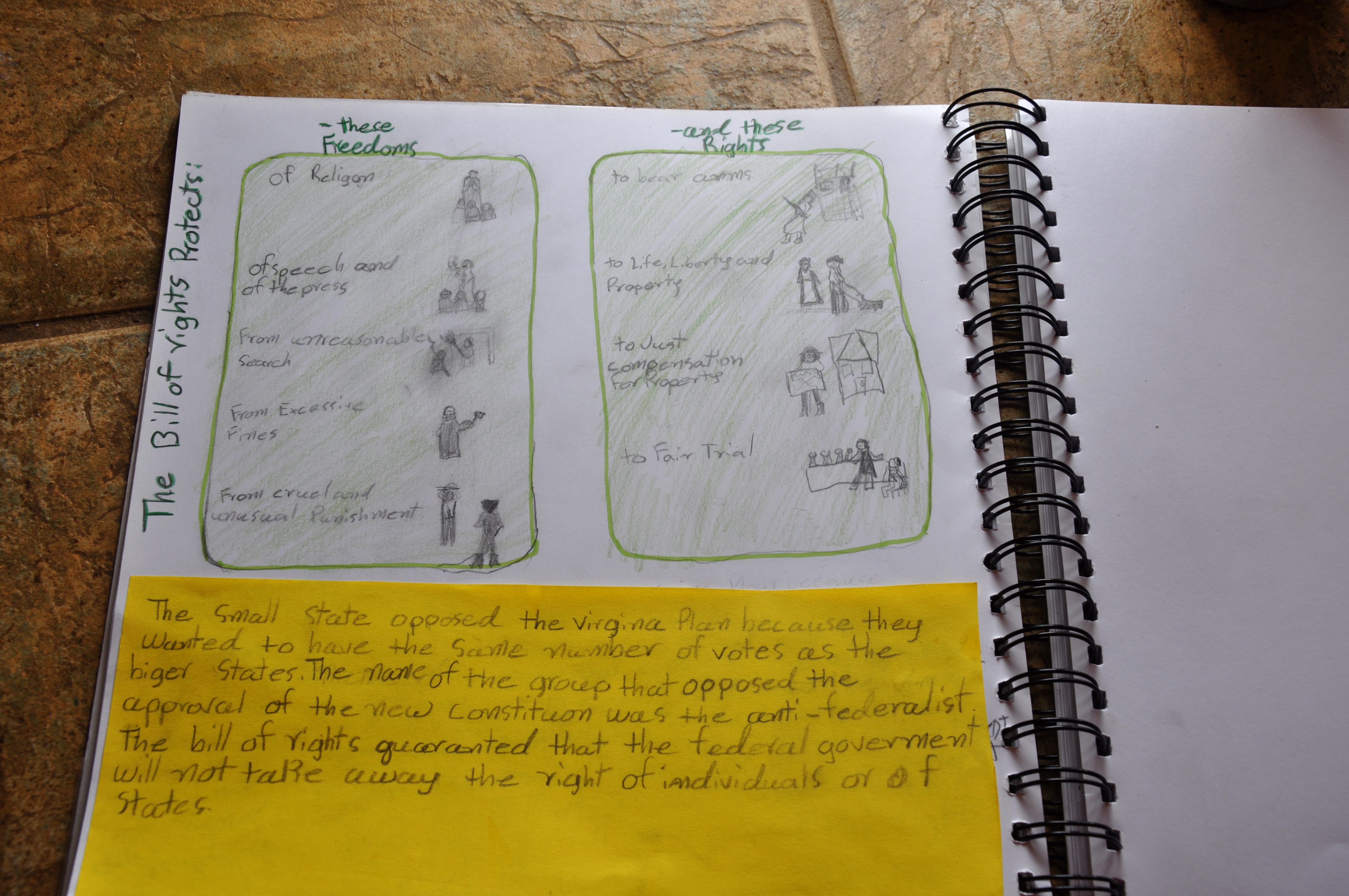
history page:
DSC_0981
Charts and graphs make excellent additions to the notebook.  They are great for review and retention!

child-centered vs child-directed education

"The authors believe wholeheartedly in the child-centered school, but only if that term is properly understood. The child is necessarily the center of the school's activity, for everything that the school undertakes, every activity in which it engages, has for its immediate object the doing of something (to or) for the child; nor can the school afford to forget, in any of its planning, what the child needs to achieve and what the child is capable of achieving. The school should be child-centered in the sense that it accepts child growth as something to be sought in everything that it does.  But this growth need not be undirected; rather it should be planned by those whose broad experience has given them a vision of the heights to which children can rise when guided wisely and lovingly.  This direction is something which children need, something that they desire, and something that they willingly accept if nothing has ever occurred to destroy their confidence."  - Voyages in English 1951 (preface)

on reading ahead

"…she further increased her advantage by reading every book assigned to me and reviewing every assignment… She spent many evenings, after a long day of teaching school, reading lengthy books. She tried to make certain that she was ahead of me so that if I had any questions about my work she would be familiar with the material. 


Mother encouraged me to work independently as much as possible… Yet she also scheduled time nearly every day for us to work together.  Whenever I missed a problem she would sit down with me and determine where I had made the mistake. Because she had worked the problems the night before it was a simple matter for to find my error and correct it.  
Although she had as many as five students during the time that I was in high school she always found time to give each of us individual instruction….The one on one interaction was critical to my mastering high school material." 

– Alexandra Swann,  No Regrets

This is remarkable to me and incredibly inspiring considering her mother had ten children in thirteen years, moved to a new city, remodeled a home, had a preemie, and went through a near fatal bowel reconstruction for one son while this was taking place.  

I have said in the past that I could not do it.  But I realize now that the alternative is often being frustrated the next day trying to help a student who is confused about material with which we are unfamiliar.  I have come to think time spent planning would be better spent knowing the literature and texts inside and out so we can discuss them and this is where I would like to focus. 

Another advantage Joyce had was that she needed only to do this once, for the rest of the children used the same books and read the same literature titles for their courses so that time invested with the first child rolled over to all the rest making it much easier with the younger children despite there being more of them. 

I suspect the prime reason she was able to do so much was that they had and answering machine and no computer….     Really mulling that one over.
DelphinEnjolras-YoungWomanReadingBy

FAQ’s

"I am overwhelmed'
"I spend a lot more time on planning than on doing."
"Our plans sound good but they peter out."
"I never feel as though I am doing enough, but we are always so busy."
"I am having a hard time staying on top of things."
"How do you know when it is "enough." (read alouds, activities etc)

I have gotten some remarkably similar letters this past month.  So similar in fact that I suspect they are touching upon an increasingly common theme. I wanted to share some of these comments (above) in case you also have ever felt this way and wondered if you were alone.  You aren't. I don't personally know many of you personally but I am willing to bet you are diligent, committed moms who have some burdensome assumptions about what it takes to do this well. 

I have a lot of thoughts on this subject but only snatches of time on the computer.  I am going to first share with you the reply I sent initially and then re-sent with variations afterwards.  We are also working on a major blog overhaul which ought to help track down old articles which address "how we do it."  


The short answer to that last question is that I only manage to do what I do because I have become ruthlessly realistic about how many hours are in a day and what I can accomplish in them. A little goes a long way – a little reading aloud, a little memory work practice, a little art, a little decluttering, a little bit of date night and time to think about something besides school.  That is also important. As a good friend remarked, part of this dilemma is due to "school" taking up an disproportionate amount of our thoughts and lives.  


Anyway here are my initial thoughts with more to come, Lord willing and the crick don't rise: 


I do think it is very hard to both create all your own curricula and follow them in a large family.  There is a lotta life happening for most of us.   I have said before that no one is doing it all – at least not well.  There is only so much time and this particular activity takes up a big chunk of it.  For me, it took up too big a chunk to justify.

Some of the most organized and successful (large) homeschool families I have known through books and real life have not gotten caught up with reinventing the wheel.  They recognized that real life is plenty full of meaningful experiences in many different areas.  They cook, they travel, they garden, they care for pets, they sew, they paint, they are part of a church community, they play music or sports or games, they welcome new babies regularly.  (some combination of the above – though certainly not all for every family)   A child in an active loving family is rarely lacking in meaningful life experiences. This does not mean school just has to 'get done' with no regard to the quality of education.  It does mean that there isn't just one definition of 'quality education' and that a curriculum designed by mom is not necessarily better than one she selects carefully from another source.   


One advantage many of these families have is that they have chosen a program and stuck with it over the long haul despite the fact that many other homeschoolers may turn up their noses at their choices.  Their children did not shrivel up.  They thrived.  Why?   Because they knew what to expect each day and week.  They had consistency.  They made the most of their materials. They know them inside out and then can easily tweak when they teach the next child. Therefore, each year finds them jumping in again and making steady progress.  They are not losing big gaps of time while mom wrestles with methodology and writing new material.  They are
n't waiting on mom because she underestimated the amount of time she would have to devote to teacher directed lessons.   They know what to do and they do it. 


Many, like your children, are not fond of open-ended assignments nor lessons that drag on and on.  That doesn't mean they don't love learning nor that their learning is less authentic.  They just don't need the type of bells and whistles activities that look quite impressive to other moms.  Instead they do very well with careful reading of various subjects.  If you feel you are selling out if you don't do extensive hands-on projects for school it may help to check out articles like this one which point out how educators…
"..in the quest for relevance or utility, are failing to reinforce the basic facts."
and that…
''Discovery is a lot of fun, but often there are questions about what students learn from it. It degenerated into activity for activity's sake."


Many parents also don't realize that they likely ARE doing LOTS of hands on activity throughout their day.  If you keep your children alongside you as you do all the many things required to run a home and family (and for some families a business or ministry) you can bet your kids are involved in plenty of projects.  You don't need to apologize for not adding yet more in their academics.  We learn best by living, not by classroom activities no matter how clever they may be. 


As far as what must be done academically if you aren't using a prepared program, I would say do math.  Do it very well.  Do not neglect to do it.  I can't stress that enough.  It composes a huge chunk of college entrance exams and upper level science depends upon it. Even if your child is entering a liberal arts field they can earn money for college by scoring well in the math area and it will make their prerequisite courses much easier.   


Write regularly.  A complicated program is not necessary.  Keep journals.  Write letters.  Proof everything and discuss their errors.  Then, have them read widely and well. If you can't keep up with booklists and thematic reading it is perfectly fine to use anthologies or prepared courses.  Many kids really and truly enjoy them.  Mine have often discovered new authors through such volumes. It may also help to remember that even a hero like Charlotte Mason did not do thematic, activity based unit studies.  She used good lit and history books (often texts at upper levels!) and usually had a couple different things going at once (ie some world history, some national history, some ancient etc.)  If you haven't read it recently a read through Colette Longo's tips for simplifying homeschool is well worth the time for the perspective it affords. 


As mentioned here before, we also try to do Morning Time daily, even if it actually happens at noon time or dinner time. <g>  That is a short time all together where we go over history dates, the names of the planets and continents, times tables, poems, greek/latin roots and so on.  Can't swing Morning Time?  No problem. Try adding some audio learning products here and there. Throw a book on tape into the cd player when you run errands. It adds up. 


Be honest with yourself about the time and energy you have to prepare and to participate.  Don't underestimate how much time it takes to run a home and family and be a loving attentive wife.  Also, don't OVERestimate how much mom-involvement is necessary for a student to learn well.  I have shared before how the head master of Kolbe Academy once said that if you can help your student with his studies, fine.  If you can't, then it's even better.  Art Robinson, Drew Campbell, and John Holt would likely concur.  Their reasoning is that you cannot learn for anyone else.  It is not a team sport. The child may have to wrangle with the subject matter but odds are in his favor that if he sticks with it he will come out on top for the effort.  He will really KNOW that material in ways he would not if he had someone holding his hand.  That isn't cruel. (we do lend a hand, just not HOLD a hand)  It is doing him a great kindness in my opinion by teaching diligence, proficiency and responsibility for his own work.  We moms t
end to shoulder that load for them too often and end up with kids who are less than self-motivated as a result.  


Almost anything we do over and over we get very good at.  There is practically no curriculum that a child cannot learn a great deal from if they just stick with it.  There is also no perfect curriculum.  There are imperfections in all programs and with having no program at all.  Part of success is due to deciding which imperfections you are most comfortable with.  For many successful large families (see above links) that choice is prepared curriculum in at least some areas. Mom is freed up to focus on character training (a big part of which is doing schoolwork responsibly) and homemaking and being a wife.  Those are areas that often suffer when we get sidetracked trying to do every academic thing from scratch.   In fact those very areas are often more key to children's success than the content of their academic lessons.  


So am I suggesting we abandon hands on learning? No. We do school projects here and there but increasingly they are spontaneous and the curriculum does not depend upon them.  When we have time we usually choose to allocate it to a real life project like making a skirt or helping an older neighbor or preparing for a church play or music recital.  Like I said – there is a lot of life happening and that's ok.  Life is good : )  We also have combined traditional materials (like texts) with alternative methods (like notebooking) with absolutely stunning results. More to follow on that!  In this way we enjoy the best of both worlds and have the time and energy to dig into projects in the world around us. 


Remember this is a marathon, not a sprint. It is a cross country journey for some of us. We have to pace ourselves.  Be tortoises, not hares. : ) A little done well and regularly goes a long way.


God bless you!
-Kim


a post script – I know its publishing with funky highlighting and if I figure out why that happened I will try to rectify when I get another moment
the gentlest of rain

"Oh this is altogether too much," you may say, "besides we leave the care of all these things to the priest or teacher." Be not deceived; it is a duty that belongs primarily to you- you may indeed invoke their help, but you can never completely shift your burden onto their shoulders.  Add to this that no one can convey instruction to your children so efficaciously and with such good results as you, both because of your greater authority over them, and because of the facilities  afforded you by the ceaseless intimate contact with them.  The gentlest and smallest quantity of rain, provided only that it falls frequently and at the proper season, does much more good to the earth than torrents of rain falling at the wrong time; and in the same way, easy and short lessons given opportunely from time to time during your ordinary household occupations, will prove much more profitable to your children than extensive instructions received elsewhere. 


Msgr John Hagen (1911)

Montessori and homeschooling videos

If you have read about Montessori but it left you wanting more then check out this  video series. A Montessori teacher explains how different materials are used and how subjects are addressed in her school.

This series of reading and writing tutorials looks outstanding.  He covers areas such as making your own books, keeping a daily journal for children (and how to go about correcting it) and more.